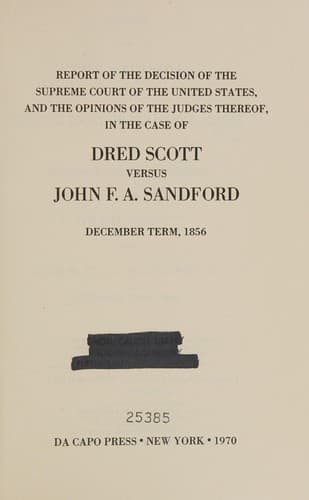
Report of the Decision of the Supreme Court of the United States, and the Opinions of the Judges Thereof, in the Case of Dred Scott versus John F. A. Sandford: December Term, 1856.United States. Supreme Court
History
Report of the Decision of the Supreme Court of the United States, and the Opinions of the Judges Thereof, in the Case of Dred Scott versus John F. A. Sandford: December Term, 1856.
United States. Supreme Court
Scott, Dred, 1809-1858; Slavery -- United States
While we respect the learning and high intelligence of the State
courts, and consider their decisions, with others, as authority, we
follow them only where they give a construction to the State statutes.
On this head, I consider myself fortunate in being able to turn to the
decision of this court, given by Mr. Justice Grier, in Pease _v._
Peck, a case from the State of Michigan, (18 Howard, 589,) decided in
December term, 1855. Speaking for the court, Judge Grier said:
"We entertain the highest respect for that learned court, (the Supreme
Court of Michigan) and in any question affecting the construction of
their own laws, where we entertain any doubt, would be glad to be
relieved from doubt and responsibility by reposing on their decision.
There are, it is true, many dicta to be found in our decisions,
averring that the courts of the United States are bound to follow the
decisions of the State courts on the construction of their own laws.
But although this may be correct, yet a rather strong expression of a
general rule, it cannot be received as the annunciation of a maxim of
universal application. Accordingly, our reports furnish many cases of
exceptions to it. In all cases where there is a settled construction
of the laws of a State, by its highest judicature established by
admitted precedent, it is the practice of the courts of the United
States to receive and adopt it, without criticism or further inquiry.
When the decisions of the State court are not consistent, we do not
feel bound to follow the last, if it is contrary to our own
convictions; and much more is this the case where, after a long course
of consistent decisions, some new light suddenly springs up, or an
excited public opinion has elicited new doctrines subversive of former
safe precedent."
These words, it appears to me, have a stronger application to the case
before us than they had to the cause in which they were spoken as the
opinion of this court; and I regret that they do not seem to be as
fresh in the recollection of some of my brethren as in my own. For
twenty-eight years, the decisions of the Supreme Court of Missouri
were consistent on all the points made in this case. But this
consistent course was suddenly terminated, whether by some new light
suddenly springing up, or an excited public opinion, or both, it is
not necessary to say. In the case of Scott _v._ Emerson, in 1852,
they were overturned and repudiated.
This, then, is the very case in which seven of my brethren declared
they would not follow the last decision. On this authority I may well
repose. I can desire no other or better basis.
But there is another ground which I deem conclusive, and which I will
re-state.
The Supreme Court of Missouri refused to notice the act of Congress or
the Constitution of Illinois, under which Dred Scott, his wife and
children, claimed that they are entitled to freedom.
Public-domain text, read in full here on John Shaqi.
Reviews
Reviews
No reviews yet
Be the first to share your thoughts on this work.
Elsewhere in the archive
Join the Discussion
Join the discussion
Sign in to leave a comment or review.
Sign InorCreate an account