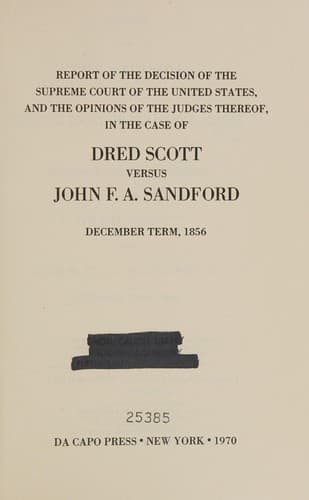
Report of the Decision of the Supreme Court of the United States, and the Opinions of the Judges Thereof, in the Case of Dred Scott versus John F. A. Sandford: December Term, 1856.United States. Supreme Court
History
Report of the Decision of the Supreme Court of the United States, and the Opinions of the Judges Thereof, in the Case of Dred Scott versus John F. A. Sandford: December Term, 1856.
United States. Supreme Court
Scott, Dred, 1809-1858; Slavery -- United States
This being rejected by the Missouri court, there was no case before
it, or least it was a case with only one side. And this is the case
which, in the opinion of this court, we are bound to follow. The
Missouri court disregards the express provisions of an act of Congress
and the Constitution of a sovereign State, both of which laws for
twenty-eight years it had not only regarded, but carried into effect.
If a State court may do this, on a question involving the liberty of a
human being, what protection do the laws afford? So far from this
being a Missouri question, it is a question, as it would seem, within
the twenty-fifth section of the judiciary act, where a right to
freedom being set up under the act of Congress, and the decision being
against such right, it may be brought for revision before this court,
from the Supreme Court of Missouri.
I think the judgment of the court below should be reversed.
* * * * *
Mr. Justice CURTIS dissenting.
I dissent from the opinion pronounced by the Chief Justice, and from
the judgment which the majority of the court think it proper to render
in this case. The plaintiff alleged, in his declaration, that he was a
citizen of the State of Missouri, and that the defendant was a citizen
of the State of New York. It is not doubted that it was necessary to
make each of these allegations, to sustain the jurisdiction of the
Circuit Court. The defendant denied, by a plea to the jurisdiction,
either sufficient or insufficient, that the plaintiff was a citizen of
the State of Missouri. The plaintiff demurred to that plea. The
Circuit Court adjudged the plea insufficient, and the first question
for our consideration is, whether the sufficiency of that plea is
before this court for judgment, upon this writ of error. The part of
the judicial power of the United States, conferred by Congress on the
Circuit Courts, being limited to certain described cases and
controversies, the question whether a particular case is within the
cognizance of a Circuit Court, may be raised by a plea to the
jurisdiction of such court. When that question has been raised, the
Circuit Court must, in the first instance, pass upon and determine it.
Whether its determination be final, or subject to review by this
appellate court, must depend upon the will of Congress; upon which
body the Constitution has conferred the power, with certain
restrictions, to establish inferior courts, to determine their
jurisdiction, and to regulate the appellate power of this court. The
twenty-second section of the judiciary act of 1789, which allows a
writ of error from final judgments of Circuit Courts, provides that
there shall be no reversal in this court, on such writ of error, for
error in ruling any plea in abatement, _other than a plea to the
jurisdiction of the court_. Accordingly it has been held, from the
origin of the court to the present day, that Circuit Courts have not
Public-domain text, read in full here on John Shaqi.
Reviews
Reviews
No reviews yet
Be the first to share your thoughts on this work.
Elsewhere in the archive
Join the Discussion
Join the discussion
Sign in to leave a comment or review.
Sign InorCreate an account