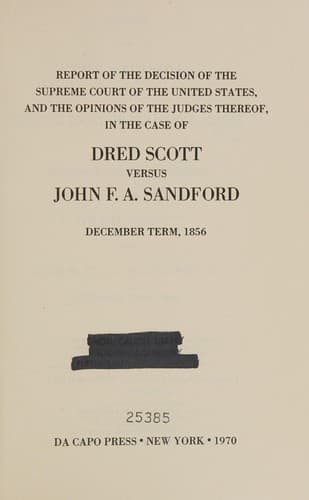
Report of the Decision of the Supreme Court of the United States, and the Opinions of the Judges Thereof, in the Case of Dred Scott versus John F. A. Sandford: December Term, 1856.United States. Supreme Court
History
Report of the Decision of the Supreme Court of the United States, and the Opinions of the Judges Thereof, in the Case of Dred Scott versus John F. A. Sandford: December Term, 1856.
United States. Supreme Court
Scott, Dred, 1809-1858; Slavery -- United States
An argument from speculative premises, however well chosen, that the
then state of opinion in the Commonwealth of Massachusetts was not
consistent with the natural rights of people of color who were born on
that soil, and that they were not, by the Constitution of 1780 of that
State, admitted to the condition of citizens, would be received with
surprise by the people of that State, who know their own political
history. It is true, beyond all controversy, that persons of color,
descended from African slaves, were by that Constitution made citizens
of the State; and such of them as have had the necessary
qualifications, have held and exercised the elective franchise, as
citizens, from that time to the present. (See Com. _v._ Aves, 18 Pick.
R., 210.)
The Constitution of New Hampshire conferred the elective franchise
upon "every inhabitant of the State having the necessary
qualifications," of which color or descent was not one.
The Constitution of New York gave the right to vote to "every male
inhabitant, who shall have resided," &c.; making no discrimination
between free colored persons and others. (See Con. of N.Y., Art. 2,
Rev. Stats. of N.Y., vol. 1, p. 126.)
That of New Jersey, to "all inhabitants of this colony, of full age,
who are worth L50 proclamation money, clear estate."
New York, by its Constitution of 1820, required colored persons to
have some qualifications as prerequisites for voting, which white
persons need not possess. And New Jersey, by its present Constitution,
restricts the right to vote to white male citizens. But these changes
can have no other effect upon the present inquiry, except to show,
that before they were made, no such restrictions existed; and colored
in common with white persons, were not only citizens of those States,
but entitled to the elective franchise on the same qualifications as
white persons, as they now are in New Hampshire and Massachusetts. I
shall not enter into an examination of the existing opinions of that
period respecting the African race, nor into any discussion concerning
the meaning of those who asserted, in the Declaration of Independence,
that all men are created equal; that they are endowed by their Creator
with certain inalienable rights; that among these are life, liberty,
and the pursuit of happiness. My own opinion is, that a calm
comparison of these assertions of universal abstract truths, and of
their own individual opinions and acts, would not leave these men
under any reproach of inconsistency; that the great truths they
asserted on that solemn occasion, they were ready and anxious to make
effectual, wherever a necessary regard to circumstances, which no
statesman can disregard without producing more evil than good, would
allow; and that it would not be just to them, nor true in itself, to
allege that they intended to say that the Creator of all men had
endowed the white race, exclusively, with the great natural rights
which the Declaration of Independence asserts.
Public-domain text, read in full here on John Shaqi.
Reviews
Reviews
No reviews yet
Be the first to share your thoughts on this work.
Elsewhere in the archive
Join the Discussion
Join the discussion
Sign in to leave a comment or review.
Sign InorCreate an account