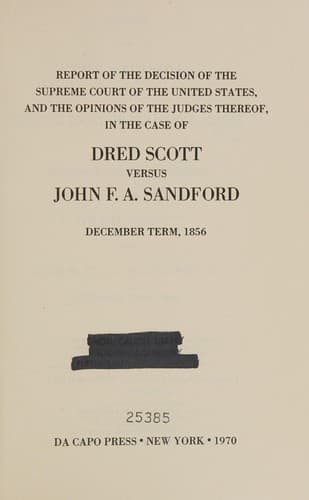
Report of the Decision of the Supreme Court of the United States, and the Opinions of the Judges Thereof, in the Case of Dred Scott versus John F. A. Sandford: December Term, 1856.United States. Supreme Court
History
Report of the Decision of the Supreme Court of the United States, and the Opinions of the Judges Thereof, in the Case of Dred Scott versus John F. A. Sandford: December Term, 1856.
United States. Supreme Court
Scott, Dred, 1809-1858; Slavery -- United States
The acts of March 3, 1813, section 1, (2 Stat. at Large, 809,) and
March 1, 1817, section 3, (3 Stat. at Large, 351,) concerning seamen,
certainly imply there may be persons of color, natives of the United
States, who are not citizens of the United States. This implication is
undoubtedly in accordance with the fact. For not only slaves, but free
persons of color, born in some of the States, are not citizens. But
there is nothing in these laws inconsistent with the citizenship of
persons of color in others of the States, nor with their being
citizens of the United States.
Whether much or little weight should be attached to the particular
phraseology of these and other laws, which were not passed with any
direct reference to this subject, I consider their tendency to be, as
already indicated, to show that, in the apprehension of their framers,
color was not a necessary qualification of citizenship. It would be
strange, if laws were found on our statute book to that effect, when,
by solemn treaties, large bodies of Mexican and North American Indians
as well as free colored inhabitants of Louisiana have been admitted to
citizenship of the United States.
In the legislative debates which preceded the admission of the State
of Missouri into the Union, this question was agitated. Its result is
found in the resolution of Congress, of March 5, 1821, for the
admission of that State into the Union. The Constitution of Missouri,
under which that State applied for admission into the Union, provided,
that it should be the duty of the Legislature "to pass laws to
prevent free negroes and mulattoes from coming to and settling in the
State, under any pretext whatever." One ground of objection to the
admission of the State under this Constitution was, that it would
require the Legislature to exclude free persons of color, who would be
entitled, under the second section of the fourth article of the
Constitution, not only to come within the State, but to enjoy there
the privileges and immunities of citizens. The resolution of Congress
admitting the State was upon the fundamental condition, "that the
Constitution of Missouri shall never be construed to authorize the
passage of any law, and that no law shall be passed in conformity
thereto, by which any citizen of either of the States of this Union
shall be excluded from the enjoyment of any of the privileges and
immunities to which such citizen is entitled under the Constitution of
the United States." It is true, that neither this legislative
declaration, nor anything in the Constitution or laws of Missouri,
could confer or take away any privilege or immunity granted by the
Constitution. But it is also true, that it expresses the then
conviction of the legislative power of the United States, that free
negroes, as citizens of some of the States, might be entitled to the
privileges and immunities of citizens in all the States.
The conclusions at which I have arrived on this part of the case are:
Public-domain text, read in full here on John Shaqi.
Reviews
Reviews
No reviews yet
Be the first to share your thoughts on this work.
Elsewhere in the archive
Join the Discussion
Join the discussion
Sign in to leave a comment or review.
Sign InorCreate an account