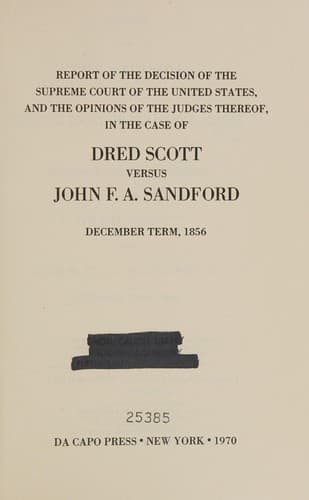
Report of the Decision of the Supreme Court of the United States, and the Opinions of the Judges Thereof, in the Case of Dred Scott versus John F. A. Sandford: December Term, 1856.United States. Supreme Court
History
Report of the Decision of the Supreme Court of the United States, and the Opinions of the Judges Thereof, in the Case of Dred Scott versus John F. A. Sandford: December Term, 1856.
United States. Supreme Court
Scott, Dred, 1809-1858; Slavery -- United States
_First._ That the free native-born citizens of each State are citizens
of the United States.
_Second._ That as free colored persons born within some of the States
are citizens of those States, such persons are also citizens of the
United States.
_Third._ That every such citizen, residing in any State, has the right
to sue and is liable to be sued in the Federal courts, as a citizen of
that State in which he resides.
_Fourth._ That as the plea to the jurisdiction in this case shows no
facts, except that the plaintiff was of African descent, and his
ancestors were sold as slaves, and as these facts are not inconsistent
with his citizenship of the United States, and his residence in the
State of Missouri, the plea to the jurisdiction was bad, and the
judgment of the Circuit Court overruling it was correct.
I dissent, therefore, from that part of the opinion of the majority of
the court, in which it is held that a person of African descent cannot
be a citizen of the United States; and I regret I must go further, and
dissent both from what I deem their assumption of authority to examine
the constitutionality of the act of Congress commonly called the
Missouri compromise act, and the grounds and conclusions announced in
their opinion.
Having first decided that they were bound to consider the sufficiency
of the plea to the jurisdiction of the Circuit Court, and having
decided that this plea showed that the Circuit Court had not
jurisdiction, and consequently that this is a case to which the
judicial power of the United States does not extend, they have gone on
to examine the merits of the case as they appeared on the trial before
the court and jury, on the issues joined on the pleas in bar, and so
have reached the question of the power of Congress to pass the act of
1820. On so grave a subject as this, I feel obliged to say that, in my
opinion, such an exertion of judicial power transcends the limits of
the authority of the court, as described by its repeated decisions,
and, as I understand, acknowledged in this opinion of the majority of
the court.
Public-domain text, read in full here on John Shaqi.
Reviews
Reviews
No reviews yet
Be the first to share your thoughts on this work.
Elsewhere in the archive
Join the Discussion
Join the discussion
Sign in to leave a comment or review.
Sign InorCreate an account