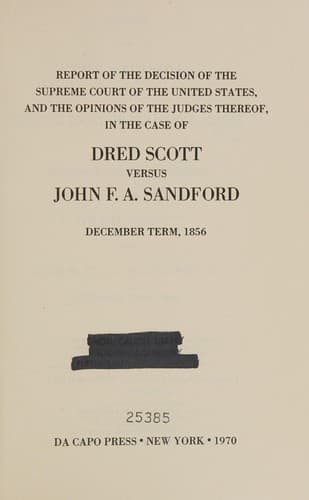
Report of the Decision of the Supreme Court of the United States, and the Opinions of the Judges Thereof, in the Case of Dred Scott versus John F. A. Sandford: December Term, 1856.United States. Supreme Court
History
Report of the Decision of the Supreme Court of the United States, and the Opinions of the Judges Thereof, in the Case of Dred Scott versus John F. A. Sandford: December Term, 1856.
United States. Supreme Court
Scott, Dred, 1809-1858; Slavery -- United States
In the course of that opinion, it became necessary to comment on the
case of Legrand _v._ Darnall, (reported in 2 Peters's R., 664.) In
that case, a bill was filed, by one alleged to be a citizen of
Maryland, against one alleged to be a citizen of Pennsylvania. The
bill stated that the defendant was the son of a white man by one of
his slaves; and that the defendant's father devised to him certain
lands, the title to which was put in controversy by the bill. These
facts were admitted in the answer, and upon these and other facts the
court made its decree, founded on the principle that a devise of land
by a master to a slave was by implication also a bequest of his
freedom. The facts that the defendant was of African descent, and was
born a slave, were not only before the court, but entered into the
entire substance of its inquiries. The opinion of the majority of my
brethren in this case disposes of the case of Legrand _v._ Darnall, by
saying, among other things, that as the fact that the defendant was
born a slave only came before this court on the bill and answer, it
was then too late to raise the question of the personal disability of
the party, and therefore that decision is altogether inapplicable in
this case.
In this I concur. Since the decision of this court in Livingston _v._
Story, (11 Pet., 351,) the law has been settled, that when the
declaration or bill contains the necessary averments of citizenship,
this court cannot look at the record, to see whether those averments
are true, except so far as they are put in issue by a plea to the
jurisdiction. In that case, the defendant denied by his answer that
Mr. Livingston was a citizen of New York, as he had alleged in the
bill. Both parties went into proofs. The court refused to examine
those proofs, with reference to the personal disability of the
plaintiff. This is the settled law of the court, affirmed so lately
as Shepherd _v._ Graves, (14 How., 27,) and Wickliff _v._ Owings, (17
How., 51.) (See also De Wolf _v._ Rabaud, 1 Pet., 476.) But I do not
understand this to be a rule which the court may depart from at its
pleasure. If it be a rule, it is as binding on the court as on the
suitors. If it removes from the latter the power to take any objection
to the personal disability of a party alleged by the record to be
competent, which is not shown by a plea to the jurisdiction, it is
because the court are forbidden by law to consider and decide on
objections so taken. I do not consider it to be within the scope of
the judicial power of the majority of the court to pass upon any
question respecting the plaintiff's citizenship in Missouri, save that
raised by the plea to the jurisdiction; and I do not hold any opinion
of this court, or any court, binding, when expressed on a question not
legitimately before it. (Carroll _v._ Carroll, 16 How., 275.) The
judgment of this court is, that the case is to be dismissed for want
Public-domain text, read in full here on John Shaqi.
Reviews
Reviews
No reviews yet
Be the first to share your thoughts on this work.
Elsewhere in the archive
Join the Discussion
Join the discussion
Sign in to leave a comment or review.
Sign InorCreate an account