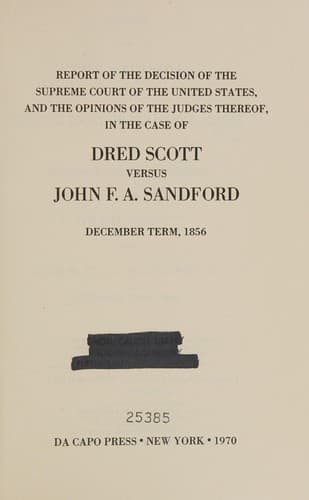
Report of the Decision of the Supreme Court of the United States, and the Opinions of the Judges Thereof, in the Case of Dred Scott versus John F. A. Sandford: December Term, 1856.United States. Supreme Court
History
Report of the Decision of the Supreme Court of the United States, and the Opinions of the Judges Thereof, in the Case of Dred Scott versus John F. A. Sandford: December Term, 1856.
United States. Supreme Court
Scott, Dred, 1809-1858; Slavery -- United States
of jurisdiction, because the plaintiff was not a citizen of Missouri,
as he alleged in his declaration. Into that judgment, according to the
settled course of this court, nothing appearing after a plea to the
merits can enter. A great question of constitutional law, deeply
affecting the peace and welfare of the country, is not, in my opinion,
a fit subject to be thus reached.
But as, in my opinion, the Circuit Court had jurisdiction, I am
obliged to consider the question whether its judgment on the merits of
the case should stand or be reversed.
The residence of the plaintiff in the State of Illinois, and the
residence of himself and his wife in the territory acquired from
France lying north of latitude thirty-six degrees thirty minutes, and
north of the State of Missouri, are each relied on by the plaintiff in
error. As the residence in the territory affects the plaintiff's wife
and children as well as himself, I must inquire what was its effect.
The general question may be stated to be, whether the plaintiff's
_status_, as a slave, was so changed by his residence within that
territory, that he was not a slave in the State of Missouri, at the
time this action was brought.
In such cases, two inquiries arise, which may be confounded, but
should be kept distinct.
The first is, what was the law of the Territory into which the master
and slave went, respecting the relation between them?
The second is, whether the State of Missouri recognises and allows the
effect of that law of the Territory, on the _status_ of the slave, on
his return within its jurisdiction.
As to the first of these questions, the will of States and nations,
by whose municipal law slavery is not recognised, has been manifested
in three different ways.
One is, absolutely to dissolve the relation, and terminate the rights
of the master existing under the law of the country whence the parties
came. This is said by Lord Stowell, in the case of the slave Grace, (2
Hag. Ad. R., 94,) and by the Supreme Court of Louisiana in the case of
Maria [Transcriber's Note: Marie] Louise _v._ Marot, (9 Louis. R.,
473,) to be the law of France; and it has been the law of several
States of this Union, in respect to slaves introduced under certain
conditions. (Wilson _v._ Isabel, 5 Call's R., 430; Hunter _v._ Hulcher
[Transcriber's Note: Fulcher], 1 Leigh, 172; Stewart _v._ Oaks, 5 Har.
and John., 107.)
Public-domain text, read in full here on John Shaqi.
Reviews
Reviews
No reviews yet
Be the first to share your thoughts on this work.
Elsewhere in the archive
Join the Discussion
Join the discussion
Sign in to leave a comment or review.
Sign InorCreate an account