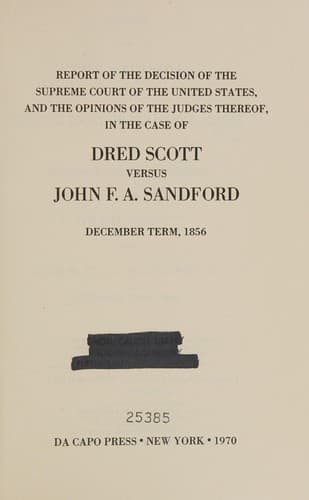
Report of the Decision of the Supreme Court of the United States, and the Opinions of the Judges Thereof, in the Case of Dred Scott versus John F. A. Sandford: December Term, 1856.United States. Supreme Court
History
Report of the Decision of the Supreme Court of the United States, and the Opinions of the Judges Thereof, in the Case of Dred Scott versus John F. A. Sandford: December Term, 1856.
United States. Supreme Court
Scott, Dred, 1809-1858; Slavery -- United States
It must be borne in mind that in this case there is no ground for the
inquiry, whether it be the will of the State of Missouri not to
recognise the validity of the marriage of a fugitive slave, who
escapes into a State or country where slavery is not allowed, and
there contracts a marriage; or the validity of such a marriage, where
the master, being a citizen of the State of Missouri, voluntarily goes
with his slave, _in itinere_, into a State or country which does not
permit slavery to exist, and the slave there contracts marriage
without the consent of his master; for in this case, it is agreed, Dr.
Emerson did consent; and no further question can arise concerning his
rights, so far as their assertion is inconsistent with the validity of
the marriage. Nor do I know of any ground for the assertion that this
marriage was in fraud of any law of Missouri. It has been held by this
court, that a bequest of property by a master to his slave, by
necessary implication entitles the slave to his freedom; because, only
as a freeman could he take and hold the bequest. (Legrand _v._
Darnall, 2 Pet. R., 664.) It has also been held, that when a master
goes with his slave to reside for an indefinite period in a State
where slavery is not tolerated, this operates as an act of
manumission; because it is sufficiently expressive of the consent of
the master that the slave should be free. (2 Marshall's Ken. R., 470;
14 Martin's Louis. R., 401.)
What, then, shall we say of the consent of the master, that the slave
may contract a lawful marriage, attended with all the civil rights and
duties which belong to that relation; that he may enter into a
relation which none but a free man can assume--a relation which
involves not only the rights and duties of the slave, but those of the
other party to the contract, and of their descendants to the remotest
generation? In my judgment, there can be no more effectual abandonment
of the legal rights of a master over his slave, than by the consent of
the master that the slave should enter into a contract of marriage, in
a free State, attended by all the civil rights and obligations which
belong to that condition.
And any claim by Dr. Emerson, or any one claiming under him, the
effect of which is to deny the validity of this marriage, and the
lawful paternity of the children born from it, wherever asserted, is,
in my judgment, a claim inconsistent with good faith and sound reason,
as well as with the rules of international law. And I go further: in
my opinion, a law of the State of Missouri, which should thus annul a
marriage, lawfully contracted by these parties while resident in
Wisconsin, not in fraud of any law of Missouri, or of any right of Dr.
Emerson, who consented thereto, would be a law impairing the
obligation of a contract, and within the prohibition of the
Constitution of the United States. (See 4 Wheat., 629, 695, 696.)
Public-domain text, read in full here on John Shaqi.
Reviews
Reviews
No reviews yet
Be the first to share your thoughts on this work.
Elsewhere in the archive
Join the Discussion
Join the discussion
Sign in to leave a comment or review.
Sign InorCreate an account