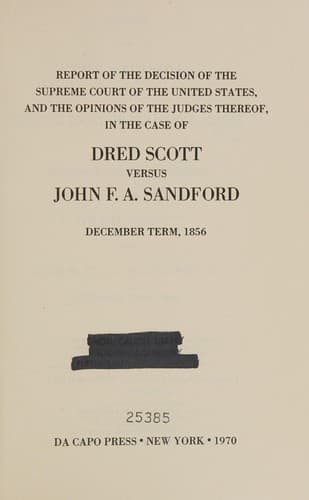
Report of the Decision of the Supreme Court of the United States, and the Opinions of the Judges Thereof, in the Case of Dred Scott versus John F. A. Sandford: December Term, 1856.United States. Supreme Court
History
Report of the Decision of the Supreme Court of the United States, and the Opinions of the Judges Thereof, in the Case of Dred Scott versus John F. A. Sandford: December Term, 1856.
United States. Supreme Court
Scott, Dred, 1809-1858; Slavery -- United States
With the weight of either of these considerations, when presented to
Congress to influence its action, this court has no concern. One or
the other may be justly entitled to guide or control the legislative
judgment upon what is a needful regulation. The question here is,
whether they are sufficient to authorize this court to insert into
this clause of the Constitution an exception of the exclusion or
allowance of slavery, not found therein, nor in any other part of that
instrument. To engraft on any instrument a substantive exception not
found in it, must be admitted to be a matter attended with great
difficulty. And the difficulty increases with the importance of the
instrument, and the magnitude and complexity of the interests involved
in its construction. To allow this to be done with the Constitution,
upon reasons purely political, renders its judicial interpretation
impossible--because judicial tribunals, as such, cannot decide upon
political considerations. Political reasons have not the requisite
certainty to afford rules of juridical interpretation. They are
different in different men. They are different in the same men at
different times. And when a strict interpretation of the Constitution,
according to the fixed rules which govern the interpretation of laws,
is abandoned, and the theoretical opinions of individuals are allowed
to control its meaning, we have no longer a Constitution; we are under
the government of individual men, who for the time being have power to
declare what the Constitution is, according to their own views of what
it ought to mean. When such a method of interpretation of the
Constitution obtains, in place of a republican Government, with
limited and defined powers, we have a Government which is merely an
exponent of the will of Congress; or what, in my opinion, would not be
preferable, an exponent of the individual political opinions of the
members of this court.
If it can be shown, by anything in the Constitution itself, that when
it confers on Congress the power to make _all_ needful rules and
regulations respecting the territory belonging to the United States,
the exclusion or the allowance of slavery was excepted; or if anything
in the history of this provision tends to show that such an exception
was intended by those who framed and adopted the Constitution to be
introduced into it, I hold it to be my duty carefully to consider, and
to allow just weight to such considerations in interpreting the
positive text of the Constitution. But where the Constitution has said
_all_ needful rules and regulations, I must find something more than
theoretical reasoning to induce me to say it did not mean all.
There have been eminent instances in this court closely analogous to
this one, in which such an attempt to introduce an exception, not
found in the Constitution itself, has failed of success.
Public-domain text, read in full here on John Shaqi.
Reviews
Reviews
No reviews yet
Be the first to share your thoughts on this work.
Elsewhere in the archive
Join the Discussion
Join the discussion
Sign in to leave a comment or review.
Sign InorCreate an account