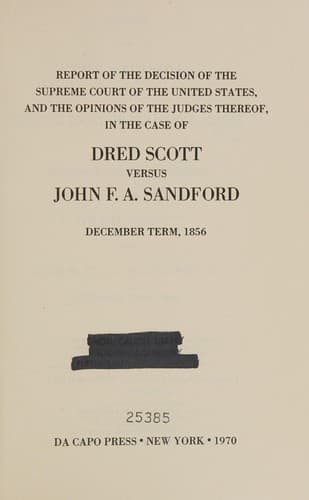
Report of the Decision of the Supreme Court of the United States, and the Opinions of the Judges Thereof, in the Case of Dred Scott versus John F. A. Sandford: December Term, 1856.United States. Supreme Court
History
Report of the Decision of the Supreme Court of the United States, and the Opinions of the Judges Thereof, in the Case of Dred Scott versus John F. A. Sandford: December Term, 1856.
United States. Supreme Court
Scott, Dred, 1809-1858; Slavery -- United States
By the eighth section of the first article, Congress has the power of
exclusive legislation in all cases whatsoever within this District.
In the case of Loughborough _v._ Blake, (5 Whea., 324,) the question
arose, whether Congress has power to impose direct taxes on persons
and property in this District. It was insisted, that though the grant
of power was in its terms broad enough to include direct taxation, it
must be limited by the principle, that taxation and representation are
inseparable. It would not be easy to fix on any political truth,
better established or more fully admitted in our country, than that
taxation and representation must exist together. We went into the war
of the Revolution to assert it, and it is incorporated as fundamental
into all American Governments. But however true and important this
maxim may be, it is not necessarily of universal application. It was
for the people of the United States, who ordained the Constitution, to
decide whether it should or should not be permitted to operate within
this District. Their decision was embodied in the words of the
Constitution; and as that contained no such exception as would permit
the maxim to operate in this District, this court, interpreting that
language, held that the exception did not exist.
Again, the Constitution confers on Congress power to regulate commerce
with foreign nations. Under this, Congress passed an act on the 22d of
December, 1807, unlimited in duration, laying an embargo on all ships
and vessels in the ports or within the limits and jurisdiction of the
United States. No law of the United States ever pressed so severely
upon particular States. Though the constitutionality of the law was
contested with an earnestness and zeal proportioned to the ruinous
effects which were felt from it, and though, as Mr. Chief Justice
Marshall has said, (9 Wheat., 192,) "a want of acuteness in
discovering objections to a measure to which they felt the most
deep-rooted hostility will not be imputed to those who were arrayed in
opposition to this," I am not aware that the fact that it prohibited
the use of a particular species of property, belonging almost
exclusively to citizens of a few States, and this indefinitely, was
ever supposed to show that it was unconstitutional. Something much
more stringent, as a ground of legal judgment, was relied on--that the
power to regulate commerce did not include the power to annihilate
commerce.
Public-domain text, read in full here on John Shaqi.
Reviews
Reviews
No reviews yet
Be the first to share your thoughts on this work.
Elsewhere in the archive
Join the Discussion
Join the discussion
Sign in to leave a comment or review.
Sign InorCreate an account