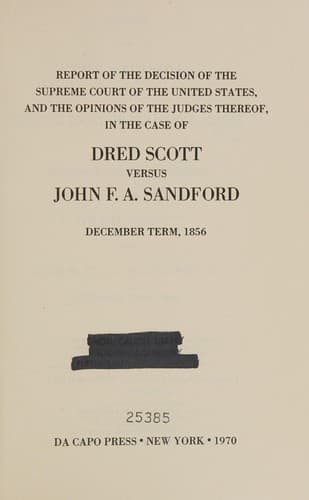
Report of the Decision of the Supreme Court of the United States, and the Opinions of the Judges Thereof, in the Case of Dred Scott versus John F. A. Sandford: December Term, 1856.United States. Supreme Court
History
Report of the Decision of the Supreme Court of the United States, and the Opinions of the Judges Thereof, in the Case of Dred Scott versus John F. A. Sandford: December Term, 1856.
United States. Supreme Court
Scott, Dred, 1809-1858; Slavery -- United States
But the decision was, that under the power to regulate commerce, the
power of Congress over the subject was restricted only by those
exceptions and limitations contained in the Constitution; and as
neither the clause in question, which was a general grant of power to
regulate commerce, nor any other clause of the Constitution, imposed
any restrictions as to the duration of an embargo, an unlimited
prohibition of the use of the shipping of the country was within the
power of Congress. On this subject, Mr. Justice Daniel, speaking for
the court in the case of United States _v._ Marigold, (9 How., 560,)
says: "Congress are, by the Constitution, vested with the power to
regulate commerce with foreign nations; and however, at periods of
high excitement, an application of the terms 'to regulate commerce,'
such as would embrace absolute prohibition, may have been questioned,
yet, since the passage of the embargo and non-intercourse laws, and
the repeated judicial sanctions these statutes have received, it can
scarcely at this day be open to doubt, that every subject falling
legitimately within the sphere of commercial regulation may be
partially or wholly excluded, when either measure shall be demanded by
the safety or the important interests of the entire nation. The power
once conceded, it may operate on any and every subject of commerce to
which the legislative discretion may apply it."
If power to regulate commerce extends to an indefinite prohibition of
the use of all vessels belonging to citizens of the several States,
and may operate, without exception, upon every subject of commerce to
which the legislative discretion may apply it, upon what grounds can I
say that power to make all needful rules and regulations respecting
the territory of the United States is subject to an exception of the
allowance or prohibition of slavery therein?
While the regulation is one "respecting the territory," while it is,
in the judgment of Congress, "a needful regulation," and is thus
completely within the words of the grant, while no other clause of the
Constitution can be shown, which requires the insertion of an
exception respecting slavery, and while the practical construction for
a period of upwards of fifty years forbids such an exception, it
would, in my opinion, violate every sound rule of interpretation to
force that exception into the Constitution upon the strength of
abstract political reasoning, which we are bound to believe the people
of the United States thought insufficient to induce them to limit the
power of Congress, because what they have said contains no such
limitation.
Public-domain text, read in full here on John Shaqi.
Reviews
Reviews
No reviews yet
Be the first to share your thoughts on this work.
Elsewhere in the archive
Join the Discussion
Join the discussion
Sign in to leave a comment or review.
Sign InorCreate an account