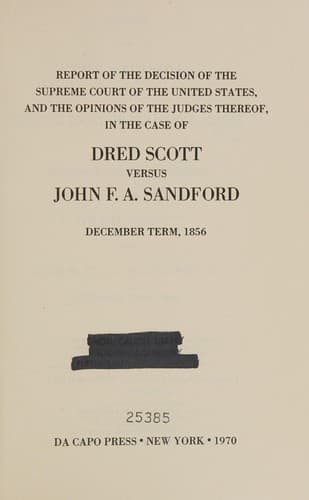
Report of the Decision of the Supreme Court of the United States, and the Opinions of the Judges Thereof, in the Case of Dred Scott versus John F. A. Sandford: December Term, 1856.United States. Supreme Court
History
Report of the Decision of the Supreme Court of the United States, and the Opinions of the Judges Thereof, in the Case of Dred Scott versus John F. A. Sandford: December Term, 1856.
United States. Supreme Court
Scott, Dred, 1809-1858; Slavery -- United States
Before I proceed further to notice some other grounds of supposed
objection to this power of Congress, I desire to say, that if it were
not for my anxiety to insist upon what I deem a correct exposition of
the Constitution, if I looked only to the purposes of the argument,
the source of the power of Congress asserted in the opinion of the
majority of the court would answer those purposes equally well. For
they admit that Congress has power to organize and govern the
Territories until they arrive at a suitable condition for admission to
the Union; they admit, also, that the kind of Government which shall
thus exist should be regulated by the condition and wants of each
Territory, and that it is necessarily committed to the discretion of
Congress to enact such laws for that purpose as that discretion may
dictate; and no limit to that discretion has been shown, or even
suggested, save those positive prohibitions to legislate, which are
found in the Constitution.
I confess myself unable to perceive any difference whatever between my
own opinion of the general extent of the power of Congress and the
opinion of the majority of the court, save that I consider it
derivable from the express language of the Constitution, while they
hold it to be silently implied from the power to acquire territory.
Looking at the power of Congress over the Territories as of the extent
just described, what positive prohibition exists in the Constitution,
which restrained Congress from enacting a law in 1820 to prohibit
slavery north of thirty-six degrees thirty minutes north latitude?
The only one suggested is that clause in the fifth article of the
amendments of the Constitution which declares that no person shall be
deprived of his life, liberty, or property, without due process of
law. I will now proceed to examine the question, whether this clause
is entitled to the effect thus attributed to it. It is necessary,
first, to have a clear view of the nature and incidents of that
particular species of property which is now in question.
Public-domain text, read in full here on John Shaqi.
Reviews
Reviews
No reviews yet
Be the first to share your thoughts on this work.
Elsewhere in the archive
Join the Discussion
Join the discussion
Sign in to leave a comment or review.
Sign InorCreate an account