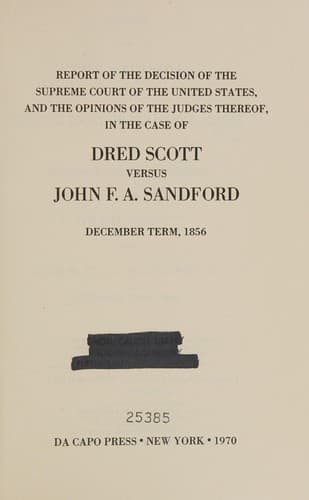
Report of the Decision of the Supreme Court of the United States, and the Opinions of the Judges Thereof, in the Case of Dred Scott versus John F. A. Sandford: December Term, 1856.United States. Supreme Court
History
Report of the Decision of the Supreme Court of the United States, and the Opinions of the Judges Thereof, in the Case of Dred Scott versus John F. A. Sandford: December Term, 1856.
United States. Supreme Court
Scott, Dred, 1809-1858; Slavery -- United States
Slavery, being contrary to natural right, is created only by municipal
law. This is not only plain in itself, and agreed by all writers on
the subject, but is inferable from the Constitution, and has been
explicitly declared by this court. The Constitution refers to slaves
as "persons held to service in one State, under the laws thereof."
Nothing can more clearly describe a _status_ created by municipal law.
In Prigg _v._ Pennsylvania, (10 Pet., 611,) this court said: "The
state of slavery is deemed to be a mere municipal regulation, founded
on and limited to the range of territorial laws." In Rankin _v._
Lydia, (2 Marsh., 12, 470,) the Supreme Court of Appeals of Kentucky
said: "Slavery is sanctioned by the laws of this State, and the right
to hold them under our municipal regulations is unquestionable. But we
view this as a right existing by positive law of a municipal
character, without foundation in the law of nature or the unwritten
common law." I am not acquainted with any case or writer questioning
the correctness of this doctrine. (See also 1 Burge, Col. and For.
Laws, 738-741, where the authorities are collected.)
The _status_ of slavery is not necessarily always attended with the
same powers on the part of the master. The master is subject to the
supreme power of the State, whose will controls his action towards his
slave, and this control must be defined and regulated by the municipal
law. In one State, as at one period of the Roman law, it may put the
life of the slave into the hand of the master; others, as those of the
United States, which tolerate slavery, may treat the slave as a
person, when the master takes his life; while in others, the law may
recognise a right of the slave to be protected from cruel treatment.
In other words, the _status_ of slavery embraces every condition, from
that in which the slave is known to the law simply as a chattel, with
no civil rights, to that in which he is recognised as a person for all
purposes, save the compulsory power of directing and receiving the
fruits of his labor. Which of these conditions shall attend the
_status_ of slavery, must depend on the municipal law which creates
and upholds it.
And not only must the _status_ of slavery be created and measured by
municipal law, but the rights, powers, and obligations, which grow out
of that _status_, must be defined, protected, and enforced, by such
laws. The liability of the master for the torts and crimes of his
slave, and of third persons for assaulting or injuring or harboring or
kidnapping him, the forms and modes of emancipation and sale, their
subjection to the debts of the master, succession by death of the
master, suits for freedom, the capacity of the slave to be party to a
suit, or to be a witness, with such police regulations as have existed
in all civilized States where slavery has been tolerated, are among
the subjects upon which municipal legislation becomes necessary when
slavery is introduced.
Public-domain text, read in full here on John Shaqi.
Reviews
Reviews
No reviews yet
Be the first to share your thoughts on this work.
Elsewhere in the archive
Join the Discussion
Join the discussion
Sign in to leave a comment or review.
Sign InorCreate an account