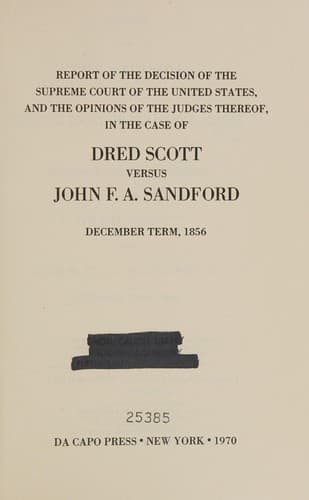
Report of the Decision of the Supreme Court of the United States, and the Opinions of the Judges Thereof, in the Case of Dred Scott versus John F. A. Sandford: December Term, 1856.United States. Supreme Court
History
Report of the Decision of the Supreme Court of the United States, and the Opinions of the Judges Thereof, in the Case of Dred Scott versus John F. A. Sandford: December Term, 1856.
United States. Supreme Court
Scott, Dred, 1809-1858; Slavery -- United States
Is it conceivable that the Constitution has conferred the right on
every citizen to become a resident on the territory of the United
States with his slaves, and there to hold them as such, but has
neither made nor provided for any municipal regulations which are
essential to the existence of slavery?
Is it not more rational to conclude that they who framed and adopted
the Constitution were aware that persons held to service under the
laws of a State are property only to the extent and under the
conditions fixed by those laws; that they must cease to be available
as property, when their owners voluntarily place them permanently
within another jurisdiction, where no municipal laws on the subject of
slavery exist; and that, being aware of these principles, and having
said nothing to interfere with or displace them, or to compel Congress
to legislate in any particular manner on the subject, and having
empowered Congress to make all needful rules and regulations
respecting the territory of the United States, it was their intention
to leave to the discretion of Congress what regulations, if any,
should be made concerning slavery therein? Moreover, if the right
exists, what are its limits, and what are its conditions? If citizens
of the United States have the right to take their slaves to a
Territory, and hold them there as slaves, without regard to the laws
of the Territory, I suppose this right is not to be restricted to the
citizens of slaveholding States. A citizen of a State which does not
tolerate slavery can hardly be denied the power of doing the same
thing. And what law of slavery does either take with him to the
Territory? If it be said to be those laws respecting slavery which
existed in the particular State from which each slave last came, what
an anomaly is this? Where else can we find, under the law of any
civilized country, the power to introduce and permanently continue
diverse systems of foreign municipal law, for holding persons in
slavery? I say, not merely to introduce, but permanently to continue,
these anomalies. For the offspring of the female must be governed by
the foreign municipal laws to which the mother was subject; and when
any slave is sold or passes by succession on the death of the owner,
there must pass with him, by a species of subrogation, and as a kind
of unknown _jus in re_, the foreign municipal laws which constituted,
regulated, and preserved, the _status_ of the slave before his
exportation. Whatever theoretical importance may be now supposed to
belong to the maintenance of such a right, I feel a perfect conviction
that it would, if ever tried, prove to be as impracticable in fact, as
it is, in my judgment, monstrous in theory.
Public-domain text, read in full here on John Shaqi.
Reviews
Reviews
No reviews yet
Be the first to share your thoughts on this work.
Elsewhere in the archive
Join the Discussion
Join the discussion
Sign in to leave a comment or review.
Sign InorCreate an account