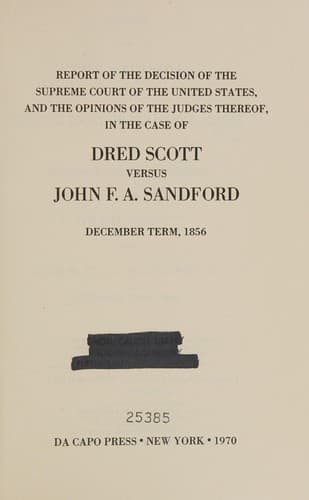
Report of the Decision of the Supreme Court of the United States, and the Opinions of the Judges Thereof, in the Case of Dred Scott versus John F. A. Sandford: December Term, 1856.United States. Supreme Court
History
Report of the Decision of the Supreme Court of the United States, and the Opinions of the Judges Thereof, in the Case of Dred Scott versus John F. A. Sandford: December Term, 1856.
United States. Supreme Court
Scott, Dred, 1809-1858; Slavery -- United States
I consider the assumption which lies at the basis of this theory to be
unsound; not in its just sense, and when properly understood, but in
the sense which has been attached to it. That assumption is, that the
territory ceded by France was acquired for the equal benefit of all
the citizens of the United States. I agree to the position. But it was
acquired for their benefit in their collective, not their individual,
capacities. It was acquired for their benefit, as an organized
political society, subsisting as "the people of the United States,"
under the Constitution of the United States; to be administered justly
and impartially, and as nearly as possible for the equal benefit of
every individual citizen, according to the best judgment and
discretion of the Congress; to whose power, as the Legislature of the
nation which acquired it, the people of the United States have
committed its administration. Whatever individual claims may be
founded on local circumstances, or sectional differences of condition,
cannot, in my opinion, be recognised in this court, without arrogating
to the judicial branch of the Government powers not committed to it;
and which, with all the unaffected respect I feel for it, when acting
in its proper sphere, I do not think it fitted to wield.
Nor, in my judgment, will the position, that a prohibition to bring
slaves into a Territory deprives any one of his property without due
process of law, bear examination.
It must be remembered that this restriction on the legislative power
is not peculiar to the Constitution of the United States; it was
borrowed from _Magna Charta_; was brought to America by our ancestors,
as part of their inherited liberties, and has existed in all the
States, usually in the very words of the great charter. It existed in
every political community in America in 1787, when the ordinance
prohibiting slavery north and west of the Ohio was passed.
Public-domain text, read in full here on John Shaqi.
Reviews
Reviews
No reviews yet
Be the first to share your thoughts on this work.
Elsewhere in the archive
Join the Discussion
Join the discussion
Sign in to leave a comment or review.
Sign InorCreate an account