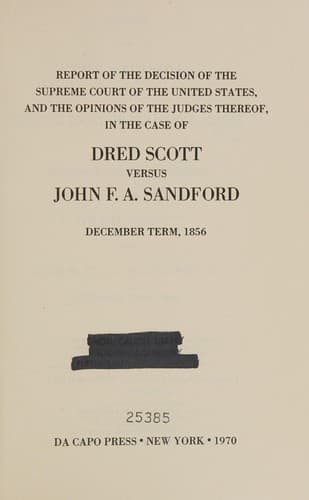
Report of the Decision of the Supreme Court of the United States, and the Opinions of the Judges Thereof, in the Case of Dred Scott versus John F. A. Sandford: December Term, 1856.United States. Supreme Court
History
Report of the Decision of the Supreme Court of the United States, and the Opinions of the Judges Thereof, in the Case of Dred Scott versus John F. A. Sandford: December Term, 1856.
United States. Supreme Court
Scott, Dred, 1809-1858; Slavery -- United States
And if a prohibition of slavery in a Territory in 1820 violated this
principle of _Magna Charta_, the ordinance of 1787 also violated it;
and what power had, I do not say the Congress of the Confederation
alone, but the Legislature of Virginia, or the Legislature of any or
all the States of the Confederacy, to consent to such a violation? The
people of the States had conferred no such power. I think I may at
least say, if the Congress did then violate _Magna Charta_ by the
ordinance, no one discovered that violation. Besides, if the
prohibition upon all persons, citizens as well as others, to bring
slaves into a Territory, and a declaration that if brought they shall
be free, deprives citizens of their property without due process of
law, what shall we say of the legislation of many of the slaveholding
States which have enacted the same prohibition? As early as October,
1778, a law was passed in Virginia, that thereafter no slave should be
imported into that Commonwealth by sea or by land, and that every
slave who should be imported should become free. A citizen of Virginia
purchased in Maryland a slave who belonged to another citizen of
Virginia, and removed with the slave to Virginia. The slave sued for
her freedom, and recovered it; as may be seen in Wilson _v._ Isabel,
(5 Call's R., 425.) See also Hunter _v._ Hulsher [Transcriber's Note:
Fulcher], (1 Leigh, 172;) and a similar law has been recognised as
valid in Maryland, in Stewart _v._ Oaks, (5 Har. and John., 107.) I am
not aware that such laws, though they exist in many States, were ever
supposed to be in conflict with the principle of _Magna Charta_
incorporated into the State Constitutions. It was certainly understood
by the Convention which framed the Constitution, and has been so
understood ever since, that, under the power to regulate commerce,
Congress could prohibit the importation of slaves; and the exercise of
the power was restrained till 1808. A citizen of the United States
owns slaves in Cuba, and brings them to the United States, where they
are set free by the legislation of Congress. Does this legislation
deprive him of his property without due process of law? If so, what
becomes of the laws prohibiting the slave trade? If not, how can a
similar regulation respecting a Territory violate the fifth amendment
of the Constitution?
Public-domain text, read in full here on John Shaqi.
Reviews
Reviews
No reviews yet
Be the first to share your thoughts on this work.
Elsewhere in the archive
Join the Discussion
Join the discussion
Sign in to leave a comment or review.
Sign InorCreate an account