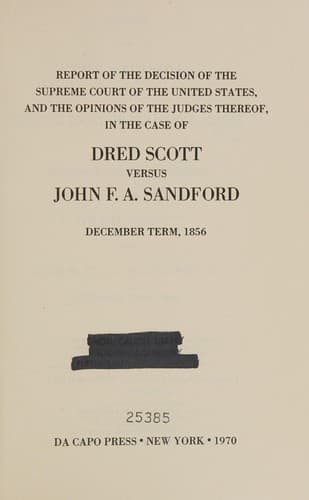
Report of the Decision of the Supreme Court of the United States, and the Opinions of the Judges Thereof, in the Case of Dred Scott versus John F. A. Sandford: December Term, 1856.United States. Supreme Court
History
Report of the Decision of the Supreme Court of the United States, and the Opinions of the Judges Thereof, in the Case of Dred Scott versus John F. A. Sandford: December Term, 1856.
United States. Supreme Court
Scott, Dred, 1809-1858; Slavery -- United States
Some reliance was placed by the defendant's counsel upon the fact that
the prohibition of slavery in this territory was in the words, "that
slavery, &c., shall be and is hereby _forever_ prohibited." But the
insertion of the word _forever_ can have no legal effect. Every
enactment not expressly limited in its duration continues in force
until repealed or abrogated by some competent power, and the use of
the word "forever" can give to the law no more durable operation. The
argument is, that Congress cannot so legislate as to bind the future
States formed out of the territory, and that in this instance it has
attempted to do so. Of the political reasons which may have induced
the Congress to use these words, and which caused them to expect that
subsequent Legislatures would conform their action to the then general
opinion of the country that it ought to be permanent, this court can
take no cognizance.
However fit such considerations are to control the action of Congress,
and however reluctant a statesman may be to disturb what has been
settled, every law made by Congress may be repealed, and, saving
private rights, and public rights gained by States, its repeal is
subject to the absolute will of the same power which enacted it. If
Congress had enacted that the crime of murder, committed in this
Indian Territory, north of thirty-six degrees thirty minutes, by or on
any white man, should _forever_ be punishable with death, it would
seem to me an insufficient objection to an indictment, found while it
was a Territory, that at some future day States might exist there, and
so the law was invalid, because, by its terms, it was to continue in
force forever. Such an objection rests upon a misapprehension of the
province and power of courts respecting the constitutionality of laws
enacted by the Legislature.
If the Constitution prescribe one rule, and the law another and
different rule, it is the duty of courts to declare that the
Constitution, and not the law, governs the case before them for
judgment. If the law include no case save those for which the
Constitution has furnished a different rule, or no case which the
Legislature has the power to govern, then the law can have no
operation. If it includes cases which the Legislature has power to
govern, and concerning which the Constitution does not prescribe a
different rule, the law governs those cases, though it may, in its
terms, attempt to include others, on which it cannot operate. In other
words, this court cannot declare void an act of Congress which
constitutionally embraces some cases, though other cases, within its
terms, are beyond the control of Congress, or beyond the reach of that
particular law. If, therefore, Congress had power to make a law
excluding slavery from this territory while under the exclusive power
of the United States, the use of the word "forever" does not
invalidate the law, so long as Congress has the exclusive legislative
power in the territory.
Public-domain text, read in full here on John Shaqi.
Reviews
Reviews
No reviews yet
Be the first to share your thoughts on this work.
Elsewhere in the archive
Join the Discussion
Join the discussion
Sign in to leave a comment or review.
Sign InorCreate an account