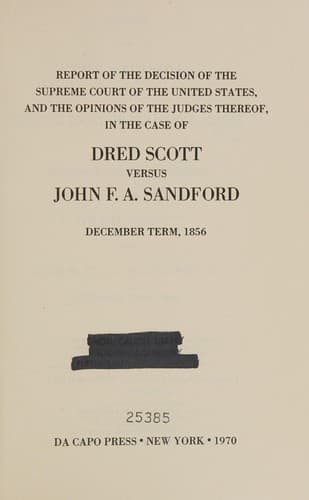
Report of the Decision of the Supreme Court of the United States, and the Opinions of the Judges Thereof, in the Case of Dred Scott versus John F. A. Sandford: December Term, 1856.United States. Supreme Court
History
Report of the Decision of the Supreme Court of the United States, and the Opinions of the Judges Thereof, in the Case of Dred Scott versus John F. A. Sandford: December Term, 1856.
United States. Supreme Court
Scott, Dred, 1809-1858; Slavery -- United States
But it is further insisted that the treaty of 1803, between the United
States and France, by which this territory was acquired, has so
restrained the constitutional powers of Congress, that it cannot, by
law, prohibit the introduction of slavery into that part of this
territory north and west of Missouri, and north of thirty-six degrees
thirty minutes north latitude.
By a treaty with a foreign nation, the United States may rightfully
stipulate that the Congress will or will not exercise its legislative
power in some particular manner, on some particular subject. Such
promises, when made, should be voluntarily kept, with the most
scrupulous good faith. But that a treaty with a foreign nation can
deprive the Congress of any part of the legislative power conferred by
the people, so that it no longer can legislate as it was empowered by
the Constitution to do, I more than doubt.
The powers of the Government do and must remain unimpaired. The
responsibility of the Government to a foreign nation, for the exercise
of those powers, is quite another matter. That responsibility is to be
met, and justified to the foreign nation, according to the
requirements of the rules of public law; but never upon the assumption
that the United States had parted with or restricted any power of
acting according to its own free will, governed solely by its own
appreciation of its duty.
The second section of the fourth article is, "This Constitution, and
the laws of the United States which shall be made in pursuance
thereof, and all treaties made or which shall be made under the
authority of the United States, shall be the supreme law of the land."
This has made treaties part of our municipal law; but it has not
assigned to them any particular degree of authority, nor declared that
laws so enacted shall be irrepealable. No supremacy is assigned to
treaties over acts of Congress. That they are not perpetual, and must
be in some way repealable, all will agree.
If the President and the Senate alone possess the power to repeal or
modify a law found in a treaty, inasmuch as they can change or
abrogate one treaty only by making another inconsistent with the
first, the Government of the United States could not act at all, to
that effect, without the consent of some foreign Government. I do not
consider, I am not aware it has ever been considered, that the
Constitution has placed our country in this helpless condition. The
action of Congress in repealing the treaties with France by the act of
July 7th, 1798, (1 Stat. at Large, 578,) was in conformity with these
views. In the case of Taylor et al. _v._ Morton, (2 Curtis's Cir. Ct.
R., 454,) I had occasion to consider this subject, and I adhere to
the views there expressed.
Public-domain text, read in full here on John Shaqi.
Reviews
Reviews
No reviews yet
Be the first to share your thoughts on this work.
Elsewhere in the archive
Join the Discussion
Join the discussion
Sign in to leave a comment or review.
Sign InorCreate an account