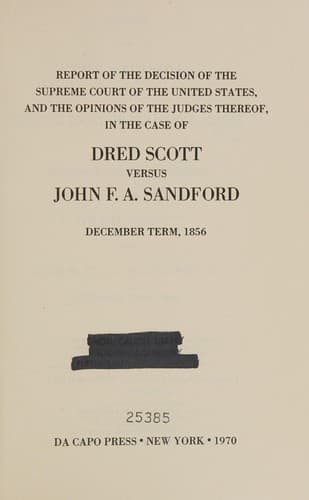
Report of the Decision of the Supreme Court of the United States, and the Opinions of the Judges Thereof, in the Case of Dred Scott versus John F. A. Sandford: December Term, 1856.United States. Supreme Court
History
Report of the Decision of the Supreme Court of the United States, and the Opinions of the Judges Thereof, in the Case of Dred Scott versus John F. A. Sandford: December Term, 1856.
United States. Supreme Court
Scott, Dred, 1809-1858; Slavery -- United States
If, therefore, it were admitted that the treaty between the United
States and France did contain an express stipulation that the United
States would not exclude slavery from so much of the ceded territory
as is now in question, this court could not declare that an act of
Congress excluding it was void by force of the treaty. Whether or no a
case existed sufficient to justify a refusal to execute such a
stipulation, would not be a judicial, but a political and legislative
question, wholly beyond the authority of this court to try and
determine. It would belong to diplomacy and legislation, and not to
the administration of existing laws. Such a stipulation in a treaty,
to legislate or not to legislate in a particular way, has been
repeatedly held in this court to address itself to the political or
the legislative power, by whose action thereon this court is bound.
(Foster _v._ Nicolson, 2 Peters, 314; Garcia _v._ Lee, 12 Peters,
519.)
But, in my judgment, this treaty contains no stipulation in any manner
affecting the action of the United States respecting the territory in
question. Before examining the language of the treaty, it is material
to bear in mind that the part of the ceded territory lying north of
thirty-six degrees thirty minutes, and west and north of the present
State of Missouri, was then a wilderness, uninhabited save by savages,
whose possessory title had not then been extinguished.
It is impossible for me to conceive on what ground France could have
advanced a claim, or could have desired to advance a claim, to
restrain the United States from making any rules and regulations
respecting this territory, which the United States might think fit to
make; and still less can I conceive of any reason which would have
induced the United States to yield to such a claim. It was to be
expected that France would desire to make the change of sovereignty
and jurisdiction as little burdensome as possible to the then
inhabitants of Louisiana, and might well exhibit even an anxious
solicitude to protect their property and persons, and secure to them
and their posterity their religious and political rights; and the
United States, as a just Government, might readily accede to all
proper stipulations respecting those who were about to have their
allegiance transferred. But what interest France could have in
uninhabited territory, which, in the language of the treaty, was to be
transferred "forever, and in full sovereignty," to the United States,
or how the United States could consent to allow a foreign nation to
interfere in its purely internal affairs, in which that foreign nation
had no concern whatever, is difficult for me to conjecture. In my
judgment, this treaty contains nothing of the kind.
Public-domain text, read in full here on John Shaqi.
Reviews
Reviews
No reviews yet
Be the first to share your thoughts on this work.
Elsewhere in the archive
Join the Discussion
Join the discussion
Sign in to leave a comment or review.
Sign InorCreate an account