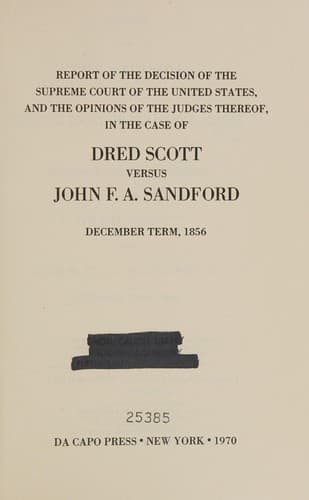
Report of the Decision of the Supreme Court of the United States, and the Opinions of the Judges Thereof, in the Case of Dred Scott versus John F. A. Sandford: December Term, 1856.United States. Supreme Court
History
Report of the Decision of the Supreme Court of the United States, and the Opinions of the Judges Thereof, in the Case of Dred Scott versus John F. A. Sandford: December Term, 1856.
United States. Supreme Court
Scott, Dred, 1809-1858; Slavery -- United States
But although this clause of the Articles of Confederation is the same
in principle with that inserted in the Constitution, yet the
comprehensive word _inhabitant_, which might be construed to include
an emancipated slave, is omitted; and the privilege is confined to
_citizens_ of the State. And this alteration in words would hardly
have been made, unless a different meaning was intended to be
conveyed, or a possible doubt removed. The just and fair inference is,
that as this privilege was about to be placed under the protection of
the General Government, and the words expounded by its tribunals, and
all power in relation to it taken from the State and its courts, it
was deemed prudent to describe with precision and caution the persons
to whom this high privilege was given--and the word _citizen_ was on
that account substituted for the words _free inhabitant_. The word
citizen excluded, and no doubt intended to exclude, foreigners who had
not become citizens of some one of the States when the Constitution
was adopted; and also every description of persons who were not fully
recognised as citizens in the several States. This, upon any fair
construction of the instruments to which we have referred, was
evidently the object and purpose of this change of words.
To all this mass of proof we have still to add, that Congress has
repeatedly legislated upon the same construction of the Constitution
that we have given. Three laws, two of which were passed almost
immediately after the Government went into operation, will be
abundantly sufficient to show this. The two first are particularly
worthy of notice, because many of the men who assisted in framing the
Constitution, and took an active part in procuring its adoption, were
then in the halls of legislation, and certainly understood what they
meant when they used the words "people of the United States" and
"citizen" in that well-considered instrument.
The first of these acts is the naturalization law, which was passed at
the second session of the first Congress, March 26, 1790, and confines
the right of becoming citizens "_to aliens being free white persons_."
Now, the Constitution does not limit the power of Congress in this
respect to white persons. And they may, if they think proper,
authorize the naturalization of any one, of any color, who was born
under allegiance to another Government. But the language of the law
above quoted, shows that citizenship at that time was perfectly
understood to be confined to the white race; and that they alone
constituted the sovereignty in the Government.
Public-domain text, read in full here on John Shaqi.
Reviews
Reviews
No reviews yet
Be the first to share your thoughts on this work.
Join the Discussion
Join the discussion
Sign in to leave a comment or review.
Sign InorCreate an account