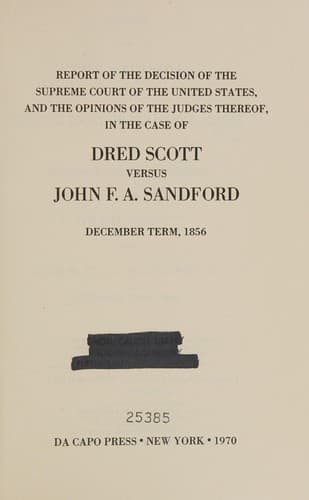
Report of the Decision of the Supreme Court of the United States, and the Opinions of the Judges Thereof, in the Case of Dred Scott versus John F. A. Sandford: December Term, 1856. — John Shaqi
Report of the Decision of the Supreme Court of the United States, and the Opinions of the Judges Thereof, in the Case of Dred Scott versus John F. A. Sandford: December Term, 1856.United States. Supreme Court
History
Report of the Decision of the Supreme Court of the United States, and the Opinions of the Judges Thereof, in the Case of Dred Scott versus John F. A. Sandford: December Term, 1856.
United States. Supreme Court
Scott, Dred, 1809-1858; Slavery -- United States
to introduce as a citizen into the political family of the United
States any one, no matter where he was born, or what might be his
character or condition; and it gave to Congress the power to confer
this character upon those only who were born outside of the dominions
of the United States. And no law of a State, therefore, passed since
the Constitution was adopted, can give any right of citizenship
outside of its own territory.
A clause similar to the one in the Constitution, in relation to the
rights and immunities of citizens of one State in the other States,
was contained in the Articles of Confederation. But there is a
difference of language, which is worthy of note. The provision in the
Articles of Confederation was, "that the _free inhabitants_ of each of
the States, paupers, vagabonds, and fugitives from justice, excepted,
should be entitled to all the privileges and immunities of free
citizens in the several States."
It will be observed, that under this Confederation, each State had the
right to decide for itself, and in its own tribunals, whom it would
acknowledge as a free inhabitant of another State. The term _free
inhabitant_, in the generality of its terms, would certainly include
one of the African race who had been manumitted. But no example, we
think, can be found of his admission to all the privileges of
citizenship in any State of the Union after these Articles were
formed, and while they continued in force. And, notwithstanding the
generality of the words "free inhabitants," it is very clear that,
according to their accepted meaning in that day, they did not include
the African race, whether free or not: for the fifth section of the
ninth article provides that Congress should have the power "to agree
upon the number of land forces to be raised, and to make requisitions
from each State for its quota in proportion to the number of _white_
inhabitants in such State, which requisition should be binding."
Words could hardly have been used which more strongly mark the line of
distinction between the citizen and the subject; the free and the
subjugated races. The latter were not even counted when the
inhabitants of a State were to be embodied in proportion to its
numbers for the general defence. And it cannot for a moment be
supposed, that a class of persons thus separated and rejected from
those who formed the sovereignty of the States, were yet intended to
be included under the words "free inhabitants," in the preceding
article, to whom privileges and immunities were so carefully secured
in every State.
Public-domain text, read in full here on John Shaqi.
Reviews
Reviews
No reviews yet
Be the first to share your thoughts on this work.
Join the Discussion
Join the discussion
Sign in to leave a comment or review.
Sign InorCreate an account