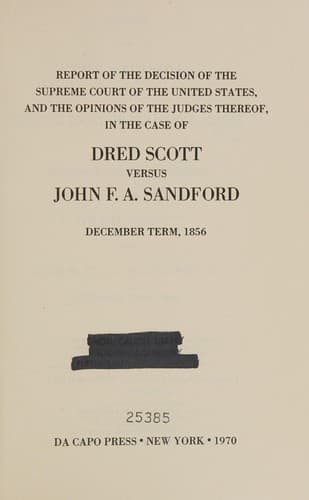
Report of the Decision of the Supreme Court of the United States, and the Opinions of the Judges Thereof, in the Case of Dred Scott versus John F. A. Sandford: December Term, 1856. — John Shaqi
Report of the Decision of the Supreme Court of the United States, and the Opinions of the Judges Thereof, in the Case of Dred Scott versus John F. A. Sandford: December Term, 1856.United States. Supreme Court
History
Report of the Decision of the Supreme Court of the United States, and the Opinions of the Judges Thereof, in the Case of Dred Scott versus John F. A. Sandford: December Term, 1856.
United States. Supreme Court
Scott, Dred, 1809-1858; Slavery -- United States
Undoubtedly, a person may be a citizen, that is, a member of the
community who form the sovereignty, although he exercises no share of
the political power, and is incapacitated from holding particular
offices. Women and minors, who form a part of the political family,
cannot vote; and when a property qualification is required to vote or
hold a particular office, those who have not the necessary
qualification cannot vote or hold the office, yet they are citizens.
So, too, a person may be entitled to vote by the law of the State, who
is not a citizen even of the State itself. And in some of the States
of the Union foreigners not naturalized are allowed to vote. And the
State may give the right to free negroes and mulattoes, but that does
not make them citizens of the State, and still less of the United
States. And the provision in the Constitution giving privileges and
immunities in other States, does not apply to them.
Neither does it apply to a person who, being the citizen of a State,
migrates to another State. For then he becomes subject to the laws of
the State in which he lives, and he is no longer a citizen of the
State from which he removed. And the State in which he resides may
then, unquestionably, determine his _status_ or condition, and place
him among the class of persons who are not recognised as citizens, but
belong to an inferior and subject race; and may deny him the
privileges and immunities enjoyed by its citizens.
But so far as mere rights of person are concerned, the provision in
question is confined to citizens of a State who are temporarily in
another State without taking up their residence there. It gives them
no political rights in the State, as to voting or holding office, or
in any other respect. For a citizen of one State has no right to
participate in the government of another. But if he ranks as a citizen
in the State to which he belongs, within the meaning of the
Constitution of the United States, then, whenever he goes into another
State, the Constitution clothes him, as to the rights of person, with
all the privileges and immunities which belong to citizens of the
State. And if persons of the African race are citizens of a State, and
of the United States, they would be entitled to all of these
privileges and immunities in every State, and the State could not
restrict them; for they would hold these privileges and immunities
under the paramount authority of the Federal Government, and its
courts would be bound to maintain and enforce them, the Constitution
and laws of the State to the contrary notwithstanding. And if the
States could limit or restrict them, or place the party in an inferior
grade, this clause of the Constitution would be unmeaning, and could
have no operation; and would give no rights to the citizen when in
another State. He would have none but what the State itself chose to
allow him. This is evidently not the construction or meaning of the
clause in question.
Public-domain text, read in full here on John Shaqi.
Reviews
Reviews
No reviews yet
Be the first to share your thoughts on this work.
Join the Discussion
Join the discussion
Sign in to leave a comment or review.
Sign InorCreate an account