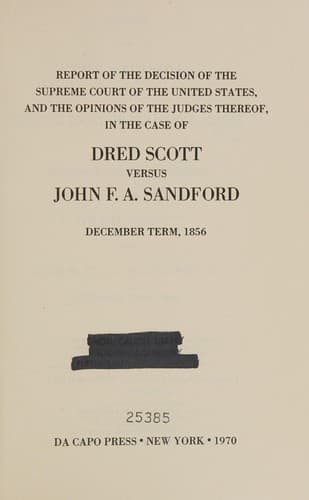
Report of the Decision of the Supreme Court of the United States, and the Opinions of the Judges Thereof, in the Case of Dred Scott versus John F. A. Sandford: December Term, 1856.United States. Supreme Court
History
Report of the Decision of the Supreme Court of the United States, and the Opinions of the Judges Thereof, in the Case of Dred Scott versus John F. A. Sandford: December Term, 1856.
United States. Supreme Court
Scott, Dred, 1809-1858; Slavery -- United States
It guaranties rights to the citizen, and the State
cannot withhold them. And these rights are of a character and would
lead to consequences which make it absolutely certain that the African
race were not included under the name of citizens of a State, and were
not in the contemplation of the framers of the Constitution when these
privileges and immunities were provided for the protection of the
citizen in other States.
The case of Legrand _v._ Darnall (2 Peters, 664) has been referred to
for the purpose of showing that this court has decided that the
descendant of a slave may sue as a citizen in a court of the United
States; but the case itself shows that the question did not arise and
could not have arisen in the case.
It appears from the report, that Darnall was born in Maryland, and was
the son of a white man by one of his slaves, and his father executed
certain instruments to manumit him, and devised to him some landed
property in the State. This property Darnall afterwards sold to
Legrand, the appellant, who gave his notes for the purchase-money. But
becoming afterwards apprehensive that the appellee had not been
emancipated according to the laws of Maryland, he refused to pay the
notes until he could be better satisfied as to Darnall's right to
convey. Darnall, in the mean time, had taken up his residence in
Pennsylvania, and brought suit on the notes, and recovered judgment in
the Circuit Court for the district of Maryland.
The whole proceeding, as appears by the report, was an amicable one;
Legrand being perfectly willing to pay the money, if he could obtain a
title, and Darnall not wishing him to pay unless he could make him a
good one. In point of fact, the whole proceeding was under the
direction of the counsel who argued the case for the appellee, who was
the mutual friend of the parties, and confided in by both of them, and
whose only object was to have the rights of both parties established
by judicial decision in the most speedy and least expensive manner.
Public-domain text, read in full here on John Shaqi.
Reviews
Reviews
No reviews yet
Be the first to share your thoughts on this work.
Join the Discussion
Join the discussion
Sign in to leave a comment or review.
Sign InorCreate an account