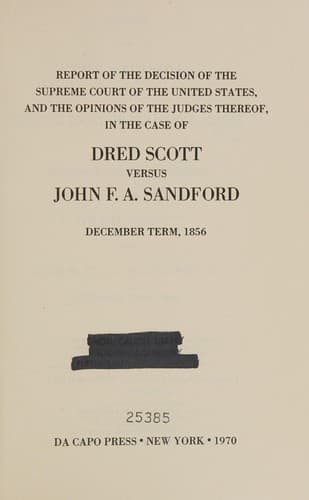
Report of the Decision of the Supreme Court of the United States, and the Opinions of the Judges Thereof, in the Case of Dred Scott versus John F. A. Sandford: December Term, 1856. — John Shaqi
Report of the Decision of the Supreme Court of the United States, and the Opinions of the Judges Thereof, in the Case of Dred Scott versus John F. A. Sandford: December Term, 1856.United States. Supreme Court
History
Report of the Decision of the Supreme Court of the United States, and the Opinions of the Judges Thereof, in the Case of Dred Scott versus John F. A. Sandford: December Term, 1856.
United States. Supreme Court
Scott, Dred, 1809-1858; Slavery -- United States
We proceed, therefore, to inquire whether the facts relied on by the
plaintiff entitled him to his freedom.
The case, as he himself states it, on the record brought here by his
writ of error, is this:
The plaintiff was a negro slave, belonging to Dr. Emerson, who was a
surgeon in the army of the United States. In the year 1834, he took
the plaintiff from the State of Missouri to the military post at Rock
Island, in the State of Illinois, and held him there as a slave until
the month of April or May, 1836. At the time last mentioned, said Dr.
Emerson removed the plaintiff from said military post at Rock Island
to the military post at Fort Snelling, situate on the west bank of the
Mississippi river, in the Territory known as Upper Louisiana, acquired
by the United States of France, and situate north of the latitude of
thirty-six degrees thirty minutes north, and north of the State of
Missouri. Said Dr. Emerson held the plaintiff in slavery at said Fort
Snelling, from said last-mentioned date until the year 1838.
In the year 1835, Harriet, who is named in the second count of the
plaintiff's declaration, was the negro slave of Major Taliaferro, who
belonged to the army of the United States. In that year, 1835, said
Major Taliaferro took said Harriet to said Fort Snelling, a military
post, situated as hereinbefore stated, and kept her there as a slave
until the year 1836, and then sold and delivered her as a slave, at
said Fort Snelling, unto the said Dr. Emerson hereinbefore named. Said
Dr. Emerson held said Harriet in slavery at said Fort Snelling until
the year 1838.
In the year 1836, the plaintiff and Harriet intermarried, at Fort
Snelling, with the consent of Dr. Emerson, who then claimed to be
their master and owner. Eliza and Lizzie, named in the third count of
the plaintiff's declaration, are the fruit of that marriage. Eliza is
about fourteen years old, and was born on board the steamboat Gipsey,
north of the north line of the State of Missouri, and upon the river
Mississippi. Lizzie is about seven years old, and was born in the
State of Missouri, at the military post called Jefferson Barracks.
In the year 1838, said Dr. Emerson removed the plaintiff and said
Harriet, and their said daughter Eliza, from said Fort Snelling to the
State of Missouri, where they have ever since resided.
Before the commencement of this suit, said Dr. Emerson sold and
conveyed the plaintiff, and Harriet, Eliza, and Lizzie, to the
defendant, as slaves, and the defendant has ever since claimed to hold
them, and each of them, as slaves.
In considering this part of the controversy, two questions arise: 1.
Was he, together with his family, free in Missouri by reason of the
stay in the territory of the United States hereinbefore mentioned?
And 2. If they were not, is Scott himself free by reason of his
removal to Rock Island, in the State of Illinois, as stated in the
above admissions?
We proceed to examine the first question.
Public-domain text, read in full here on John Shaqi.
Reviews
Reviews
No reviews yet
Be the first to share your thoughts on this work.
Join the Discussion
Join the discussion
Sign in to leave a comment or review.
Sign InorCreate an account