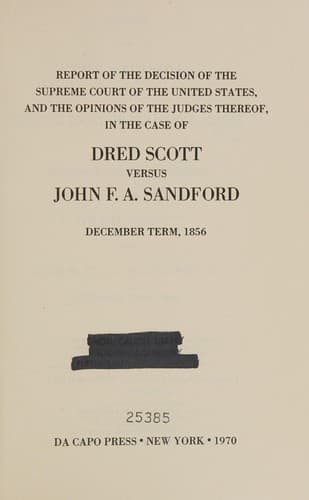
Report of the Decision of the Supreme Court of the United States, and the Opinions of the Judges Thereof, in the Case of Dred Scott versus John F. A. Sandford: December Term, 1856. — John Shaqi
Report of the Decision of the Supreme Court of the United States, and the Opinions of the Judges Thereof, in the Case of Dred Scott versus John F. A. Sandford: December Term, 1856.United States. Supreme Court
History
Report of the Decision of the Supreme Court of the United States, and the Opinions of the Judges Thereof, in the Case of Dred Scott versus John F. A. Sandford: December Term, 1856.
United States. Supreme Court
Scott, Dred, 1809-1858; Slavery -- United States
It can scarcely be necessary to pursue such a question further. The
want of jurisdiction in the court below may appear on the record
without any plea in abatement. This is familiarly the case where a
court of chancery has exercised jurisdiction in a case where the
plaintiff had a plain and adequate remedy at law, and it so appears by
the transcript when brought here by appeal. So also where it appears
that a court of admiralty has exercised jurisdiction in a case
belonging exclusively to a court of common law. In these cases there
is no plea in abatement. And for the same reason, and upon the same
principles, where the defect of jurisdiction is patent on the record,
this court is bound to reverse the judgment, although the defendant
has not pleaded in abatement to the jurisdiction of the inferior
court.
The cases of Jackson _v._ Ashton and of Capron _v._ Van Noorden, to
which we have referred in a previous part of this opinion, are
directly in point. In the last-mentioned case, Capron brought an
action against Van Noorden in a Circuit Court of the United States,
without showing, by the usual averments of citizenship, that the court
had jurisdiction. There was no plea in abatement put in, and the
parties went to trial upon the merits. The court gave judgment in
favor of the defendant with costs. The plaintiff thereupon brought his
writ of error, and this court reversed the judgment given in favor of
the defendant, and remanded the case with directions to dismiss it,
because it did not appear by the transcript that the Circuit Court had
jurisdiction.
The case before us still more strongly imposes upon this court the
duty of examining whether the court below has not committed an error,
in taking jurisdiction and giving a judgment for costs in favor of the
defendant; for in Capron _v._ Van Noorden the judgment was reversed,
because it did _not appear_ that the parties were citizens of
different States. They might or might not be. But in this case it
_does appear_ that the plaintiff was born a slave; and if the facts
upon which he relies have not made him free, then it appears
affirmatively on the record that he is not a citizen, and consequently
his suit against Sandford was not a suit between citizens of different
States, and the court had no authority to pass any judgment between
the parties. The suit ought, in this view of it, to have been
dismissed by the Circuit Court, and its judgment in favor of Sandford
is erroneous, and must be reversed.
It is true that the result either way, by dismissal or by a judgment
for the defendant, makes very little, if any, difference in a
pecuniary or personal point of view to either party. But the fact that
the result would be very nearly the same to the parties in either form
of judgment would not justify this court in sanctioning an error in
the judgment which is patent on the record, and which, if sanctioned,
might be drawn into precedent, and lead to serious mischief and
injustice in some future suit.
Public-domain text, read in full here on John Shaqi.
Reviews
Reviews
No reviews yet
Be the first to share your thoughts on this work.
Join the Discussion
Join the discussion
Sign in to leave a comment or review.
Sign InorCreate an account