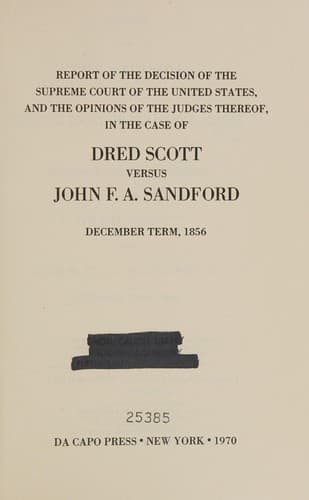
Report of the Decision of the Supreme Court of the United States, and the Opinions of the Judges Thereof, in the Case of Dred Scott versus John F. A. Sandford: December Term, 1856. — John Shaqi
Report of the Decision of the Supreme Court of the United States, and the Opinions of the Judges Thereof, in the Case of Dred Scott versus John F. A. Sandford: December Term, 1856.United States. Supreme Court
History
Report of the Decision of the Supreme Court of the United States, and the Opinions of the Judges Thereof, in the Case of Dred Scott versus John F. A. Sandford: December Term, 1856.
United States. Supreme Court
Scott, Dred, 1809-1858; Slavery -- United States
At the times mentioned in the plaintiff's declaration, the
defendant, claiming to be owner as aforesaid, laid his hands
upon said plaintiff, Harriet, Eliza, and Lizzie, and
imprisoned them, doing in this respect, however, no more
than what he might lawfully do, if they were of right his
slaves at such times.
Further proof may be given on the trial for either party.
It is agreed that Dred Scott brought suit for his freedom in
the Circuit Court of St. Louis county; that there was a
verdict and judgment in his favor; that on a writ of error
to the Supreme Court the judgment below was reversed, and
the same remanded to the Circuit Court, where it has been
continued to await the decision of this case.
In May, 1854, the cause went before a jury, who found the
following verdict, viz: "As to the first issue joined in
this case, we of the jury find the defendant not guilty; and
as to the issue secondly above joined, we of the jury find
that, before and at the time when, &c., in the first count
mentioned, the said Dred Scott was a negro slave, the lawful
property of the defendant; and as to the issue thirdly above
joined, we, the jury, find that, before and at the time
when, &c., in the second and third counts mentioned, the
said Harriet, wife of said Dred Scott, and Eliza and Lizzie,
the daughters of the said Dred Scott, were negro slaves, the
lawful property of the defendant."
Whereupon, the court gave judgment for the defendant.
After an ineffectual motion for a new trial, the plaintiff
filed the following bill of exceptions.
On the trial of this cause by the jury, the plaintiff, to
maintain the issues on his part, read to the jury the
following agreed statement of facts, (see agreement above.)
No further testimony was given to the jury by either party.
Thereupon the plaintiff moved the court to give to the jury
the following instruction, viz:
"That, upon the facts agreed to by the parties, they ought
to find for the plaintiff. The court refused to give such
instruction to the jury, and the plaintiff, to such refusal,
then and there duly excepted."
The court then gave the following instruction to the jury,
on motion of the defendant:
"The jury are instructed, that upon the facts in this case,
the law is with the defendant." The plaintiff excepted to
this instruction.
Upon these exceptions, the case came up to this court.
It was argued at December term, 1855, and ordered to be
reargued at the present term.
It was now argued by _Mr. Blair_ and _Mr. G.F. Curtis_
[Transcriber's Note: should be 'G.T. Curtis,' for George
Ticknor Curtis] for the plaintiff in error, and by _Mr.
Geyer_ and _Mr. Johnson_ for the defendant in error.
Public-domain text, read in full here on John Shaqi.
Reviews
Reviews
No reviews yet
Be the first to share your thoughts on this work.
Join the Discussion
Join the discussion
Sign in to leave a comment or review.
Sign InorCreate an account