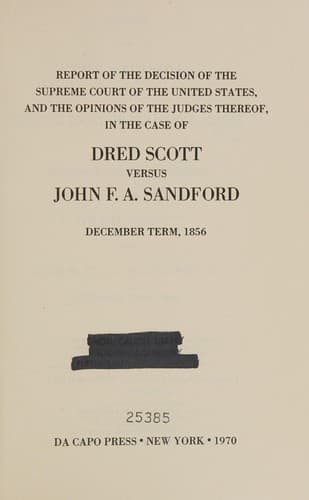
Report of the Decision of the Supreme Court of the United States, and the Opinions of the Judges Thereof, in the Case of Dred Scott versus John F. A. Sandford: December Term, 1856.United States. Supreme Court
History
Report of the Decision of the Supreme Court of the United States, and the Opinions of the Judges Thereof, in the Case of Dred Scott versus John F. A. Sandford: December Term, 1856.
United States. Supreme Court
Scott, Dred, 1809-1858; Slavery -- United States
The reporter regrets that want of room will not allow him to
give the arguments of counsel; but he regrets it the less,
because the subject is thoroughly examined in the opinion of
the court, the opinions of the concurring judges, and the
opinions of the judges who dissented from the judgment of
the court.
* * * * *
Mr. Chief Justice TANEY delivered the opinion of the court.
This case has been twice argued. After the argument at the last term,
differences of opinion were found to exist among the members of the
court; and as the questions in controversy are of the highest
importance, and the court was at that time much pressed by the
ordinary business of the term, it was deemed advisable to continue the
case, and direct a reargument on some of the points, in order that we
might have an opportunity of giving to the whole subject a more
deliberate consideration. It has accordingly been again argued by
counsel, and considered by the court; and I now proceed to deliver its
opinion.
There are two leading questions presented by the record:
1. Had the Circuit Court of the United States jurisdiction to hear and
determine the case between these parties? And
2. If it had jurisdiction, is the judgment it has given erroneous or
not?
The plaintiff in error, who was also the plaintiff in the court below,
was, with his wife and children, held as slaves by the defendant, in
the State of Missouri; and he brought this action in the Circuit Court
of the United States for that district, to assert the title of himself
and his family to freedom.
The declaration is in the form usually adopted in that State to try
questions of this description, and contains the averment necessary to
give the court jurisdiction; that he and the defendant are citizens of
different States; that is, that he is a citizen of Missouri, and the
defendant a citizen of New York.
The defendant pleaded in abatement to the jurisdiction of the court,
that the plaintiff was not a citizen of the State of Missouri, as
alleged in his declaration, being a negro of African descent, whose
ancestors were of pure African blood, and who were brought into this
country and sold as slaves.
To this plea the plaintiff demurred, and the defendant joined in
demurrer. The court overruled the plea, and gave judgment that the
defendant should answer over. And he thereupon put in sundry pleas in
bar, upon which issues were joined; and at the trial the verdict and
judgment were in his favor. Whereupon the plaintiff brought this writ
of error.
Before we speak of the pleas in bar, it will be proper to dispose of
the questions which have arisen on the plea in abatement.
That plea denies the right of the plaintiff to sue in a court of the
United States, for the reasons therein stated.
Public-domain text, read in full here on John Shaqi.
Reviews
Reviews
No reviews yet
Be the first to share your thoughts on this work.
Join the Discussion
Join the discussion
Sign in to leave a comment or review.
Sign InorCreate an account