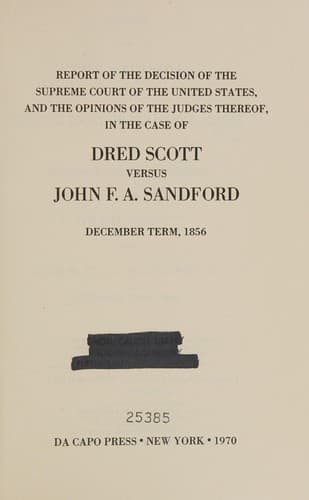
Report of the Decision of the Supreme Court of the United States, and the Opinions of the Judges Thereof, in the Case of Dred Scott versus John F. A. Sandford: December Term, 1856. — John Shaqi
Report of the Decision of the Supreme Court of the United States, and the Opinions of the Judges Thereof, in the Case of Dred Scott versus John F. A. Sandford: December Term, 1856.United States. Supreme Court
History
Report of the Decision of the Supreme Court of the United States, and the Opinions of the Judges Thereof, in the Case of Dred Scott versus John F. A. Sandford: December Term, 1856.
United States. Supreme Court
Scott, Dred, 1809-1858; Slavery -- United States
It was this Congress that accepted the cession from Virginia. They had
no power to accept it under the Articles of Confederation. But they
had an undoubted right, as independent sovereignties, to accept any
cession of territory for their common benefit, which all of them
assented to; and it is equally clear, that as their common property,
and having no superior to control them, they had the right to exercise
absolute dominion over it, subject only to the restrictions which
Virginia had imposed in her act of cession. There was, as we have
said, no Government of the United States then in existence with
special enumerated and limited powers. The territory belonged to
sovereignties, who, subject to the limitations above mentioned, had a
right to establish any form of government they pleased, by compact or
treaty among themselves, and to regulate rights of person and rights
of property in the territory, as they might deem proper. It was by a
Congress, representing the authority of these several and separate
sovereignties, and acting under their authority and command, (but not
from any authority derived from the Articles of Confederation,) that
the instrument usually called the ordinance of 1787 was adopted;
regulating in much detail the principles and the laws by which this
territory should be governed; and among other provisions, slavery is
prohibited in it. We do not question the power of the States, by
agreement among themselves, to pass this ordinance, nor its obligatory
force in the territory, while the confederation or league of the
States in their separate sovereign character continued to exist.
Public-domain text, read in full here on John Shaqi.
Reviews
Reviews
No reviews yet
Be the first to share your thoughts on this work.
Join the Discussion
Join the discussion
Sign in to leave a comment or review.
Sign InorCreate an account