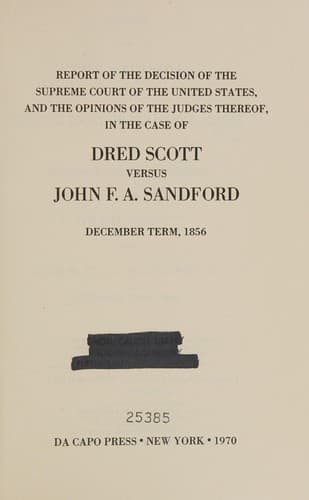
Report of the Decision of the Supreme Court of the United States, and the Opinions of the Judges Thereof, in the Case of Dred Scott versus John F. A. Sandford: December Term, 1856. — John Shaqi
Report of the Decision of the Supreme Court of the United States, and the Opinions of the Judges Thereof, in the Case of Dred Scott versus John F. A. Sandford: December Term, 1856.United States. Supreme Court
History
Report of the Decision of the Supreme Court of the United States, and the Opinions of the Judges Thereof, in the Case of Dred Scott versus John F. A. Sandford: December Term, 1856.
United States. Supreme Court
Scott, Dred, 1809-1858; Slavery -- United States
This was the state of things when the Constitution of the United
States was formed. The territory ceded by Virginia belonged to the
several confederated States as common property, and they had united in
establishing in it a system of government and jurisprudence, in order
to prepare it for admission as States, according to the terms of the
cession. They were about to dissolve this federative Union, and to
surrender a portion of their independent sovereignty to a new
Government, which, for certain purposes, would make the people of the
several States one people, and which was to be supreme and controlling
within its sphere of action throughout the United States; but this
Government was to be carefully limited in its powers, and to exercise
no authority beyond those expressly granted by the Constitution, or
necessarily to be implied from the language of the instrument, and the
objects it was intended to accomplish; and as this league of States
would, upon the adoption of the new Government, cease to have any
power over the territory, and the ordinance they had agreed upon be
incapable of execution, and a mere nullity, it was obvious that some
provision was necessary to give the new Government sufficient power to
enable it to carry into effect the objects for which it was ceded, and
the compacts and agreements which the States had made with each other
in the exercise of their powers of sovereignty. It was necessary that
the lands should be sold to pay the war debt; that a Government and
system of jurisprudence should be maintained in it, to protect the
citizens of the United States who should migrate to the territory, in
their rights of person and of property. It was also necessary that the
new Government, about to be adopted, should be authorized to maintain
the claim of the United States to the unappropriated lands in North
Carolina and Georgia, which had not then been ceded, but the cession
of which was confidently anticipated upon some terms that would be
arranged between the General Government and these two States. And,
moreover, there were many articles of value besides this property in
land, such as arms, military stores, munitions, and ships of war,
which were the common property of the States, when acting in their
independent characters as confederates, which neither the new
Government nor any one else would have a right to take possession of,
or control, without authority from them; and it was to place these
things under the guardianship and protection of the new Government,
and to clothe it with the necessary powers, that the clause was
inserted in the Constitution which gives Congress the power "to
dispose of and make all needful rules and regulations respecting the
territory or other property belonging to the United States." It was
intended for a specific purpose, to provide for the things we have
mentioned. It was to transfer to the new Government the property then
Public-domain text, read in full here on John Shaqi.
Reviews
Reviews
No reviews yet
Be the first to share your thoughts on this work.
Join the Discussion
Join the discussion
Sign in to leave a comment or review.
Sign InorCreate an account