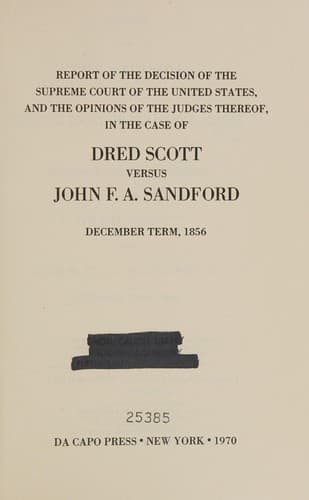
Report of the Decision of the Supreme Court of the United States, and the Opinions of the Judges Thereof, in the Case of Dred Scott versus John F. A. Sandford: December Term, 1856. — John Shaqi
Report of the Decision of the Supreme Court of the United States, and the Opinions of the Judges Thereof, in the Case of Dred Scott versus John F. A. Sandford: December Term, 1856.United States. Supreme Court
History
Report of the Decision of the Supreme Court of the United States, and the Opinions of the Judges Thereof, in the Case of Dred Scott versus John F. A. Sandford: December Term, 1856.
United States. Supreme Court
Scott, Dred, 1809-1858; Slavery -- United States
This view of the subject is confirmed by the manner in which the
present Government of the United States dealt with the subject as soon
as it came into existence. It must be borne in mind that the same
States that formed the Confederation also formed and adopted the new
Government, to which so large a portion of their former sovereign
powers were surrendered. It must also be borne in mind that all of
these same States which had then ratified the new Constitution were
represented in the Congress which passed the first law for the
government of this territory; and many of the members of that
legislative body had been deputies from the States under the
Confederation--had united in adopting the ordinance of 1787, and
assisted in forming the new Government under which they were then
acting, and whose powers they were then exercising. And it is obvious
from the law they passed to carry into effect the principles and
provisions of the ordinance, that they regarded it as the act of the
States done in the exercise of their legitimate powers at the time.
The new Government took the territory as it found it, and in the
condition in which it was transferred, and did not attempt to undo
anything that had been done. And, among the earliest laws passed under
the new Government, is one reviving the ordinance of 1787, which had
become inoperative and a nullity upon the adoption of the
Constitution. This law introduces no new form or principles for its
government, but recites, in the preamble, that it is passed in order
that this ordinance may continue to have full effect, and proceeds to
make only those rules and regulations which were needful to adapt it
to the new Government, into whose hands the power had fallen. It
appears, therefore, that this Congress regarded the purposes to which
the land in this Territory was to be applied, and the form of
government and principles of jurisprudence which were to prevail
there, while it remained in the Territorial state, as already
determined on by the States when they had full power and right to make
the decision; and that the new Government, having received it in this
condition, ought to carry substantially into effect the plans and
principles which had been previously adopted by the States, and which
no doubt the States anticipated when they surrendered their power to
the new Government. And if we regard this clause of the Constitution
as pointing to this Territory, with a Territorial Government already
established in it, which had been ceded to the States for the purposes
hereinbefore mentioned--every word in it is perfectly appropriate and
easily understood, and the provisions it contains are in perfect
harmony with the objects for which it was ceded, and with the
condition of its government as a Territory at the time. We can, then,
easily account for the manner in which the first Congress legislated
on the subject--and can also understand why this power over the
Public-domain text, read in full here on John Shaqi.
Reviews
Reviews
No reviews yet
Be the first to share your thoughts on this work.
Join the Discussion
Join the discussion
Sign in to leave a comment or review.
Sign InorCreate an account