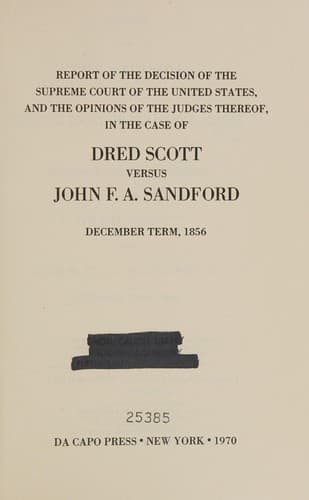
Report of the Decision of the Supreme Court of the United States, and the Opinions of the Judges Thereof, in the Case of Dred Scott versus John F. A. Sandford: December Term, 1856. — John Shaqi
Report of the Decision of the Supreme Court of the United States, and the Opinions of the Judges Thereof, in the Case of Dred Scott versus John F. A. Sandford: December Term, 1856.United States. Supreme Court
History
Report of the Decision of the Supreme Court of the United States, and the Opinions of the Judges Thereof, in the Case of Dred Scott versus John F. A. Sandford: December Term, 1856.
United States. Supreme Court
Scott, Dred, 1809-1858; Slavery -- United States
territory was associated in the same clause with the other property of
the United States, and subjected to the like power of making needful
rules and regulations. But if the clause is construed in the expanded
sense contended for, so as to embrace any territory acquired from a
foreign nation by the present Government, and to give it in such
territory a despotic and unlimited power over persons and property,
such as the confederated States might exercise in their common
property, it would be difficult to account for the phraseology used,
when compared with other grants of power--and also for its association
with the other provisions in the same clause.
The Constitution has always been remarkable for the felicity of its
arrangement of different subjects, and the perspicuity and
appropriateness of the language it uses. But if this clause is
construed to extend to territory acquired by the present Government
from a foreign nation, outside of the limits of any charter from the
British Government to a colony, it would be difficult to say, why it
was deemed necessary to give the Government the power to sell any
vacant lands belonging to the sovereignty which might be found within
it; and if this was necessary, why the grant of this power should
precede the power to legislate over it and establish a Government
there; and still more difficult to say, why it was deemed necessary so
specially and particularly to grant the power to make needful rules
and regulations in relation to any personal or movable property it
might acquire there. For the words, _other property_ necessarily, by
every known rule of interpretation, must mean property of a different
description from territory or land. And the difficulty would perhaps
be insurmountable in endeavoring to account for the last member of the
sentence, which provides that "nothing in this Constitution shall be
so construed as to prejudice any claims of the United States or any
particular State," or to say how any particular State could have
claims in or to a territory ceded by a foreign Government, or to
account for associating this provision with the preceding provisions
of the clause, with which it would appear to have no connection.
Public-domain text, read in full here on John Shaqi.
Reviews
Reviews
No reviews yet
Be the first to share your thoughts on this work.
Join the Discussion
Join the discussion
Sign in to leave a comment or review.
Sign InorCreate an account