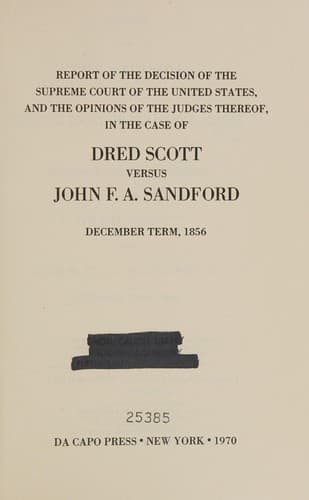
Report of the Decision of the Supreme Court of the United States, and the Opinions of the Judges Thereof, in the Case of Dred Scott versus John F. A. Sandford: December Term, 1856.United States. Supreme Court
History
Report of the Decision of the Supreme Court of the United States, and the Opinions of the Judges Thereof, in the Case of Dred Scott versus John F. A. Sandford: December Term, 1856.
United States. Supreme Court
Scott, Dred, 1809-1858; Slavery -- United States
This brings us to examine by what provision of the Constitution the
present Federal Government, under its delegated and restricted powers,
is authorized to acquire territory outside of the original limits of
the United States, and what powers it may exercise therein over the
person or property of a citizen of the United States, while it remains
a Territory, and until it shall be admitted as one of the States of
the Union.
There is certainly no power given by the Constitution to the Federal
Government to establish or maintain colonies bordering on the United
States or at a distance, to be ruled and governed at its own pleasure;
nor to enlarge its territorial limits in any way, except by the
admission of new States. That power is plainly given; and if a new
State is admitted, it needs no further legislation by Congress,
because the Constitution itself defines the relative rights and
powers, and duties of the State, and the citizens of the State, and
the Federal Government. But no power is given to acquire a Territory
to be held and governed permanently in that character.
And indeed the power exercised by Congress to acquire territory and
establish a Government there, according to its own unlimited
discretion, was viewed with great jealousy by the leading statesmen
of the day. And in the Federalist, (No. 38,) written by Mr. Madison,
he speaks of the acquisition of the Northwestern Territory by the
confederated States, by the cession from Virginia, and the
establishment of a Government there, as an exercise of power not
warranted by the Articles of Confederation, and dangerous to the
liberties of the people. And he urges the adoption of the Constitution
as a security and safeguard against such an exercise of power.
Public-domain text, read in full here on John Shaqi.
Reviews
Reviews
No reviews yet
Be the first to share your thoughts on this work.
Join the Discussion
Join the discussion
Sign in to leave a comment or review.
Sign InorCreate an account