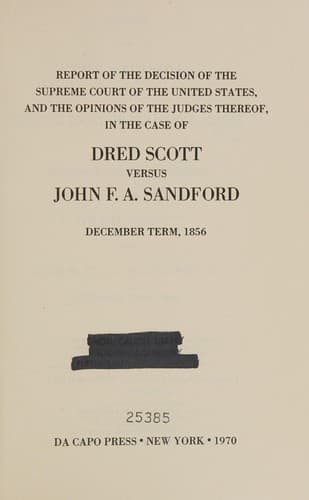
Report of the Decision of the Supreme Court of the United States, and the Opinions of the Judges Thereof, in the Case of Dred Scott versus John F. A. Sandford: December Term, 1856.United States. Supreme Court
History
Report of the Decision of the Supreme Court of the United States, and the Opinions of the Judges Thereof, in the Case of Dred Scott versus John F. A. Sandford: December Term, 1856.
United States. Supreme Court
Scott, Dred, 1809-1858; Slavery -- United States
We do not mean, however, to question the power of Congress in this
respect. The power to expand the territory of the United States by the
admission of new States is plainly given; and in the construction of
this power by all the departments of the Government, it has been held
to authorize the acquisition of territory, not fit for admission at
the time, but to be admitted as soon as its population and situation
would entitle it to admission. It is acquired to become a State, and
not to be held as a colony and governed by Congress with absolute
authority; and as the propriety of admitting a new State is committed
to the sound discretion of Congress, the power to acquire territory
for that purpose, to be held by the United States until it is in a
suitable condition to become a State upon an equal footing with the
other States, must rest upon the same discretion. It is a question for
the political department of the Government, and not the judicial; and
whatever the political department of the Government shall recognise as
within the limits of the United States, the judicial department is
also bound to recognise, and to administer in it the laws of the
United States, so far as they apply, and to maintain in the Territory
the authority and rights of the Government, and also the personal
rights and rights of property of individual citizens, as secured by
the Constitution. All we mean to say on this point is, that, as there
is no express regulation in the Constitution defining the power which
the General Government may exercise over the person or property of a
citizen in a Territory thus acquired, the court must necessarily look
to the provisions and principles of the Constitution, and its
distribution of powers, for the rules and principles by which its
decision must be governed.
Public-domain text, read in full here on John Shaqi.
Reviews
Reviews
No reviews yet
Be the first to share your thoughts on this work.
Join the Discussion
Join the discussion
Sign in to leave a comment or review.
Sign InorCreate an account