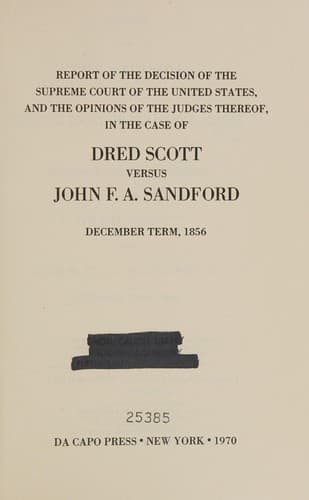
Report of the Decision of the Supreme Court of the United States, and the Opinions of the Judges Thereof, in the Case of Dred Scott versus John F. A. Sandford: December Term, 1856.United States. Supreme Court
History
Report of the Decision of the Supreme Court of the United States, and the Opinions of the Judges Thereof, in the Case of Dred Scott versus John F. A. Sandford: December Term, 1856.
United States. Supreme Court
Scott, Dred, 1809-1858; Slavery -- United States
Taking this rule to guide us, it may be safely assumed that citizens
of the United States who migrate to a Territory belonging to the
people of the United States, cannot be ruled as mere colonists,
dependent upon the will of the General Government, and to be governed
by any laws it may think proper to impose. The principle upon which
our Governments rest, and upon which alone they continue to exist, is
the union of States, sovereign and independent within their own limits
in their internal and domestic concerns, and bound together as one
people by a General Government, possessing certain enumerated and
restricted powers, delegated to it by the people of the several
States, and exercising supreme authority within the scope of the
powers granted to it, throughout the dominion of the United States. A
power, therefore, in the General Government to obtain and hold
colonies and dependent territories, over which they might legislate
without restriction, would be inconsistent with its own existence in
its present form. Whatever it acquires, it acquires for the benefit of
the people of the several States who created it. It is their trustee
acting for them, and charged with the duty of promoting the interests
of the whole people of the Union in the exercise of the powers
specifically granted.
At the time when the Territory in question was obtained by cession
from France, it contained no population fit to be associated together
and admitted as a State; and it therefore was absolutely necessary to
hold possession of it, as a Territory belonging to the United States,
until it was settled and inhabited by a civilized community capable of
self-government, and in a condition to be admitted on equal terms with
the other States as a member of the Union. But, as we have before
said, it was acquired by the General Government, as the representative
and trustee of the people of the United States, and it must therefore
be held in that character for their common and equal benefit; for it
was the people of the several States, acting through their agent and
representative, the Federal Government, who in fact acquired the
Territory in question, and the Government holds it for their common
use until it shall be associated with the other States as a member of
the Union.
Public-domain text, read in full here on John Shaqi.
Reviews
Reviews
No reviews yet
Be the first to share your thoughts on this work.
Join the Discussion
Join the discussion
Sign in to leave a comment or review.
Sign InorCreate an account