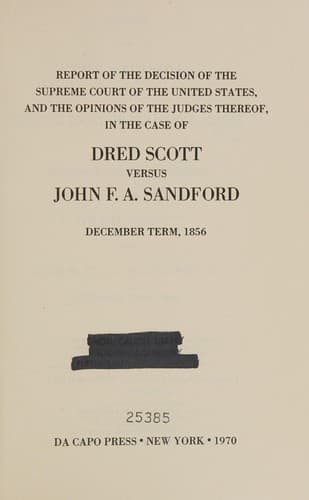
Report of the Decision of the Supreme Court of the United States, and the Opinions of the Judges Thereof, in the Case of Dred Scott versus John F. A. Sandford: December Term, 1856.United States. Supreme Court
History
Report of the Decision of the Supreme Court of the United States, and the Opinions of the Judges Thereof, in the Case of Dred Scott versus John F. A. Sandford: December Term, 1856.
United States. Supreme Court
Scott, Dred, 1809-1858; Slavery -- United States
But the power of Congress over the person or property of a citizen can
never be a mere discretionary power under our Constitution and form of
Government. The powers of the Government and the rights and privileges
of the citizen are regulated and plainly defined by the Constitution
itself. And when the Territory becomes a part of the United States,
the Federal Government enters into possession in the character
impressed upon it by those who created it. It enters upon it with its
powers over the citizen strictly defined, and limited by the
Constitution, from which it derives its own existence, and by virtue
of which alone it continues to exist and act as a Government and
sovereignty. It has no power of any kind beyond it; and it cannot,
when it enters a Territory of the United States, put off its
character, and assume discretionary or despotic powers which the
Constitution has denied to it. It cannot create for itself a new
character separated from the citizens of the United States, and the
duties it owes them under the provisions of the Constitution. The
Territory being a part of the United States, the Government and the
citizen both enter it under the authority of the Constitution, with
their respective rights defined and marked out; and the Federal
Government can exercise no power over his person or property, beyond
what that instrument confers, nor lawfully deny any right which it has
reserved.
A reference to a few of the provisions of the Constitution will
illustrate this proposition.
For example, no one, we presume, will contend that Congress can make
any law in a Territory respecting the establishment of religion, or
the free exercise thereof, or abridging the freedom of speech or of
the press, or the right of the people of the Territory peaceably to
assemble, and to petition the Government for the redress of
grievances.
Nor can Congress deny to the people the right to keep and bear arms,
nor the right to trial by jury, nor compel any one to be a witness
against himself in a criminal proceeding.
These powers, and others, in relation to rights of person, which it is
not necessary here to enumerate, are, in express and positive terms,
denied to the General Government; and the rights of private property
have been guarded with equal care. Thus the rights of property are
united with the rights of person, and placed on the same ground by the
fifth amendment to the Constitution, which provides that no person
shall be deprived of life, liberty, and property, without due process
of law. And an act of Congress which deprives a citizen of the United
States of his liberty or property, merely because he came himself or
brought his property into a particular Territory of the United States,
and who had committed no offence against the laws, could hardly be
dignified with the name of due process of law.
Public-domain text, read in full here on John Shaqi.
Reviews
Reviews
No reviews yet
Be the first to share your thoughts on this work.
Join the Discussion
Join the discussion
Sign in to leave a comment or review.
Sign InorCreate an account