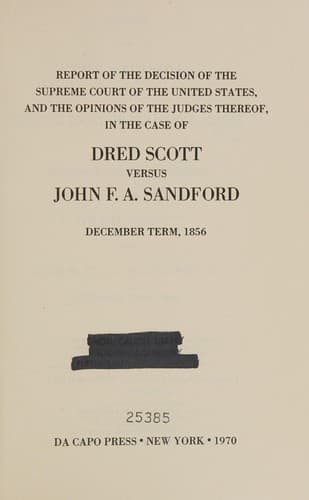
Report of the Decision of the Supreme Court of the United States, and the Opinions of the Judges Thereof, in the Case of Dred Scott versus John F. A. Sandford: December Term, 1856.United States. Supreme Court
History
Report of the Decision of the Supreme Court of the United States, and the Opinions of the Judges Thereof, in the Case of Dred Scott versus John F. A. Sandford: December Term, 1856.
United States. Supreme Court
Scott, Dred, 1809-1858; Slavery -- United States
So, too, it will hardly be contended that Congress could by law
quarter a soldier in a house in a Territory without the consent of the
owner, in time of peace; nor in time of war, but in a manner
prescribed by law. Nor could they by law forfeit the property of a
citizen in a Territory who was convicted of treason, for a longer
period than the life of the person convicted; nor take private
property for public use without just compensation.
The powers over person and property of which we speak are not only not
granted to Congress, but are in express terms denied, and they are
forbidden to exercise them. And this prohibition is not confined to
the States, but the words are general, and extend to the whole
territory over which the Constitution gives it power to legislate,
including those portions of it remaining under Territorial Government,
as well as that covered by States. It is a total absence of power
everywhere within the dominion of the United States, and places the
citizens of a Territory, so far as these rights are concerned, on the
same footing with citizens of the States, and guards them as firmly
and plainly against any inroads which the General Government might
attempt, under the plea of implied or incidental powers. And if
Congress itself cannot do this--if it is beyond the powers conferred
on the Federal Government--it will be admitted, we presume, that it
could not authorize a Territorial Government to exercise them. It
could confer no power on any local Government, established by its
authority, to violate the provisions of the Constitution.
It seems, however, to be supposed, that there is a difference between
property in a slave and other property, and that different rules may
be applied to it in expounding the Constitution of the United States.
And the laws and usages of nations, and the writings of eminent
jurists upon the relation of master and slave and their mutual rights
and duties, and the powers which Governments may exercise over it,
have been dwelt upon in the argument.
Public-domain text, read in full here on John Shaqi.
Reviews
Reviews
No reviews yet
Be the first to share your thoughts on this work.
Join the Discussion
Join the discussion
Sign in to leave a comment or review.
Sign InorCreate an account