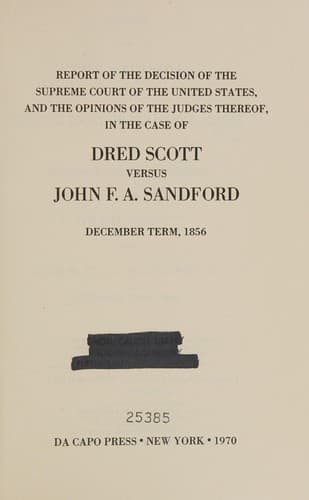
Report of the Decision of the Supreme Court of the United States, and the Opinions of the Judges Thereof, in the Case of Dred Scott versus John F. A. Sandford: December Term, 1856.United States. Supreme Court
History
Report of the Decision of the Supreme Court of the United States, and the Opinions of the Judges Thereof, in the Case of Dred Scott versus John F. A. Sandford: December Term, 1856.
United States. Supreme Court
Scott, Dred, 1809-1858; Slavery -- United States
But in considering the question before us, it must be borne in mind
that there is no law of nations standing between the people of the
United States and their Government, and interfering with their
relation to each other. The powers of the Government, and the rights
of the citizen under it, are positive and practical regulations
plainly written down. The people of the United States have delegated
to it certain enumerated powers, and forbidden it to exercise others.
It has no power over the person or property of a citizen but what the
citizens of the United States have granted. And no laws or usages of
other nations, or reasoning of statesmen or jurists upon the relations
of master and slave, can enlarge the powers of the Government, or take
from the citizens the rights they have reserved. And if the
Constitution recognises the right of property of the master in a
slave, and makes no distinction between that description of property
and other property owned by a citizen, no tribunal, acting under the
authority of the United States, whether it be legislative, executive,
or judicial, has a right to draw such a distinction, or deny to it the
benefit of the provisions and guarantees which have been provided for
the protection of private property against the encroachments of the
Government.
Now, as we have already said in an earlier part of this opinion, upon
a different point, the right of property in a slave is distinctly and
expressly affirmed in the Constitution. The right to traffic in it,
like an ordinary article of merchandise and property, was guarantied
to the citizens of the United States, in every State that might desire
it, for twenty years. And the Government in express terms is pledged
to protect it in all future time, if the slave escapes from his
owner. This is done in plain words--too plain to be misunderstood. And
no word can be found in the Constitution which gives Congress a
greater power over slave property, or which entitles property of that
kind to less protection than property of any other description. The
only power conferred is the power coupled with the duty of guarding
and protecting the owner in his rights.
Upon these considerations, it is the opinion of the court that the act
of Congress which prohibited a citizen from holding and owning
property of this kind in the territory of the United States north of
the line therein mentioned, is not warranted by the Constitution, and
is therefore void; and that neither Dred Scott himself, nor any of his
family, were made free by being carried into this territory; even if
they had been carried there by the owner, with the intention of
becoming a permanent resident.
We have so far examined the case, as it stands under the Constitution
of the United States, and the powers thereby delegated to the Federal
Government.
Public-domain text, read in full here on John Shaqi.
Reviews
Reviews
No reviews yet
Be the first to share your thoughts on this work.
Join the Discussion
Join the discussion
Sign in to leave a comment or review.
Sign InorCreate an account