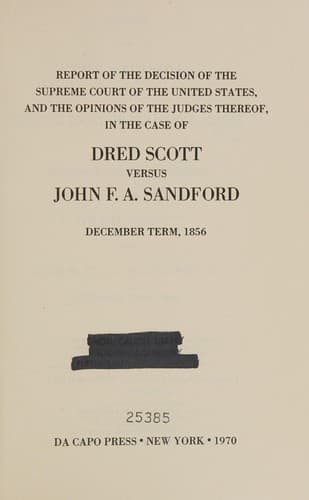
Report of the Decision of the Supreme Court of the United States, and the Opinions of the Judges Thereof, in the Case of Dred Scott versus John F. A. Sandford: December Term, 1856. — John Shaqi
Report of the Decision of the Supreme Court of the United States, and the Opinions of the Judges Thereof, in the Case of Dred Scott versus John F. A. Sandford: December Term, 1856.United States. Supreme Court
History
Report of the Decision of the Supreme Court of the United States, and the Opinions of the Judges Thereof, in the Case of Dred Scott versus John F. A. Sandford: December Term, 1856.
United States. Supreme Court
Scott, Dred, 1809-1858; Slavery -- United States
Moreover, the plaintiff, it appears, brought a similar action against
the defendant in the State court of Missouri, claiming the freedom of
himself and his family upon the same grounds and the same evidence
upon which he relies in the case before the court. The case was
carried before the Supreme Court of the State; was fully argued there;
and that court decided that neither the plaintiff nor his family were
entitled to freedom, and were still the slaves of the defendant; and
reversed the judgment of the inferior State court, which had given a
different decision. If the plaintiff supposed that this judgment of
the Supreme Court of the State was erroneous, and that this court had
jurisdiction to revise and reverse it, the only mode by which he could
legally bring it before this court was by writ of error directed to
the Supreme Court of the State, requiring it to transmit the record to
this court. If this had been done, it is too plain for argument that
the writ must have been dismissed for want of jurisdiction in this
court. The case of Strader and others _v._ Graham is directly in
point; and, indeed, independent of any decision, the language of the
25th section of the act of 1789 is too clear and precise to admit of
controversy.
But the plaintiff did not pursue the mode prescribed by law for
bringing the judgment of a State court before this court for revision,
but suffered the case to be remanded to the inferior State court,
where it is still continued, and is, by agreement of parties, to await
the judgment of this court on the point. All of this appears on the
record before us, and by the printed report of the case.
And while the case is yet open and pending in the inferior State
court, the plaintiff goes into the Circuit Court of the United States,
upon the same case and the same evidence, and against the same party,
and proceeds to judgment, and then brings here the same case from the
Circuit Court, which the law would not have permitted him to bring
directly from the State court. And if this court takes jurisdiction
in this form, the result, so far as the rights of the respective
parties are concerned, is in every respect substantially the same as
if it had in open violation of law entertained jurisdiction over the
judgment of the State court upon a writ of error, and revised and
reversed its judgment upon the ground that its opinion upon the
question of law was erroneous. It would ill become this court to
sanction such an attempt to evade the law, or to exercise an appellate
power in this circuitous way, which it is forbidden to exercise in the
direct and regular and invariable forms of judicial proceedings.
Public-domain text, read in full here on John Shaqi.
Reviews
Reviews
No reviews yet
Be the first to share your thoughts on this work.
Join the Discussion
Join the discussion
Sign in to leave a comment or review.
Sign InorCreate an account