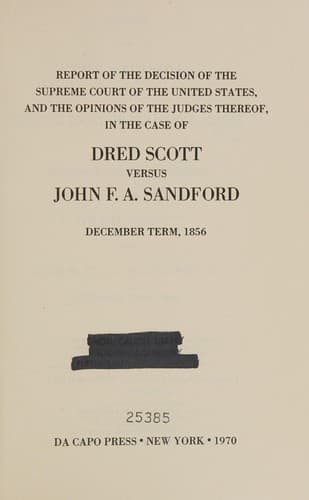
Report of the Decision of the Supreme Court of the United States, and the Opinions of the Judges Thereof, in the Case of Dred Scott versus John F. A. Sandford: December Term, 1856. — John Shaqi
Report of the Decision of the Supreme Court of the United States, and the Opinions of the Judges Thereof, in the Case of Dred Scott versus John F. A. Sandford: December Term, 1856.United States. Supreme Court
History
Report of the Decision of the Supreme Court of the United States, and the Opinions of the Judges Thereof, in the Case of Dred Scott versus John F. A. Sandford: December Term, 1856.
United States. Supreme Court
Scott, Dred, 1809-1858; Slavery -- United States
Upon the whole, therefore, it is the judgment of this court, that it
appears by the record before us that the plaintiff in error is not a
citizen of Missouri, in the sense in which that word is used in the
Constitution; and that the Circuit Court of the United States, for
that reason, had no jurisdiction in the case, and could give no
judgment in it. Its judgment for the defendant must, consequently, be
reversed, and a mandate issued, directing the suit to be dismissed for
want of jurisdiction.
* * * * *
Mr. Justice WAYNE.
Concurring as I do entirely in the opinion of the court, as it has
been written and read by the Chief Justice--without any qualification
of its reasoning or its conclusions--I shall neither read nor file an
opinion of my own in this case, which I prepared when I supposed it
might be necessary and proper for me to do so.
The opinion of the court meets fully and decides every point which was
made in the argument of the case by the counsel on either side of it.
Nothing belonging to the case has been left undecided, nor has any
point been discussed and decided which was not called for by the
record, or which was not necessary for the judicial disposition of it,
in the way that it has been done, by more than a majority of the
court.
In doing this, the court neither sought nor made the case. It was
brought to us in the course of that administration of the laws which
Congress has enacted, for the review of cases from the Circuit Courts
by the Supreme Court.
In our action upon it, we have only discharged our duty as a distinct
and efficient department of the Government, as the framers of the
Constitution meant the judiciary to be, and as the States of the Union
and the people of those States intended it should be, when they
ratified the Constitution of the United States.
The case involves private rights of value, and constitutional
principles of the highest importance, about which there had become
such a difference of opinion, that the peace and harmony of the
country required the settlement of them by judicial decision.
It would certainly be a subject of regret, that the conclusions of the
court have not been assented to by all of its members, if I did not
know from its history and my own experience how rarely it has happened
that the judges have been unanimous upon constitutional questions of
moment, and if our decision in this case had not been made by as large
a majority of them as has been usually had on constitutional questions
of importance.
Two of the judges, Mr. Justices McLean and Curtis, dissent from the
opinion of the court. A third, Mr. Justice Nelson, gives a separate
opinion upon a single point in the case, with which I concur, assuming
that the Circuit Court had jurisdiction; but he abstains altogether
from expressing any opinion upon the eighth section of the act of
1820, known commonly as the Missouri Compromise law, and six of us
declare that it was unconstitutional.
Public-domain text, read in full here on John Shaqi.
Reviews
Reviews
No reviews yet
Be the first to share your thoughts on this work.
Join the Discussion
Join the discussion
Sign in to leave a comment or review.
Sign InorCreate an account