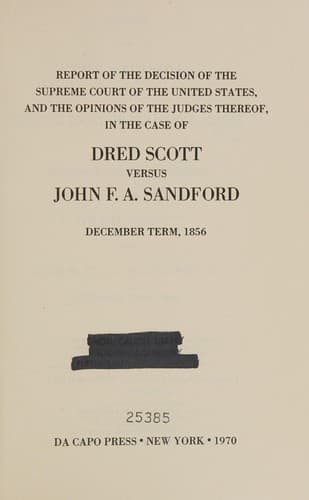
Report of the Decision of the Supreme Court of the United States, and the Opinions of the Judges Thereof, in the Case of Dred Scott versus John F. A. Sandford: December Term, 1856.United States. Supreme Court
History
Report of the Decision of the Supreme Court of the United States, and the Opinions of the Judges Thereof, in the Case of Dred Scott versus John F. A. Sandford: December Term, 1856.
United States. Supreme Court
Scott, Dred, 1809-1858; Slavery -- United States
But it has been assumed, that this court has acted extra-judicially in
giving an opinion upon the eighth section of the act of 1820, because,
as it has decided that the Circuit Court had no jurisdiction of the
case, this court had no jurisdiction to examine the case upon its
merits.
But the error of such an assertion has arisen in part from a
misapprehension of what has been heretofore decided by the Supreme
Court, in cases of a like kind with that before us; in part, from a
misapplication to the Circuit Courts of the United States, of the
rules of pleading concerning pleas to the jurisdiction which prevail
in common-law courts; and from its having been forgotten that this
case was not brought to this court by appeal or writ of error from a
State court, but by a writ of error to the Circuit Court of the United
States.
The cases cited by the Chief Justice to show that this court has now
only done what it has repeatedly done before in other cases, without
any question of its correctness, speak for themselves. The differences
between the rules concerning pleas to the jurisdiction in the courts
of the United States and common-law courts have been stated and
sustained by reasoning and adjudged cases; and it has been shown that
writs of error to a State court and to the Circuit Courts of the
United States are to be determined by different laws and principles.
In the first, it is our duty ascertain if this court has jurisdiction,
under the twenty-fifth section of the judiciary act, to review the
case _from the State court_; and if it shall be found that it has not,
the case is at end, so far as this court is concerned; for our power
to review the case upon its merits has been made, by the twenty-fifth
section, to depend upon its having jurisdiction; when it has not, this
court cannot criticise, controvert, or give any opinion upon the
merits of a case from a State court.
But in a case brought to this court, by appeal or by writ of error
from _a Circuit Court of the United States_, we begin a review of it,
_not by inquiring if this court has jurisdiction_, but if that court
has it. If the case has been decided by that court upon its merits,
but the record shows it to be deficient in those averments which by
the law of the United States must be made by the plaintiff in the
action, to give the court jurisdiction of his case, we send it back to
the court from which it was brought, with directions to be dismissed,
though it has been decided there upon its merits.
Public-domain text, read in full here on John Shaqi.
Reviews
Reviews
No reviews yet
Be the first to share your thoughts on this work.
Join the Discussion
Join the discussion
Sign in to leave a comment or review.
Sign InorCreate an account