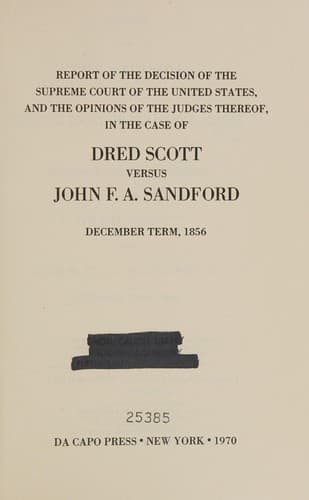
Report of the Decision of the Supreme Court of the United States, and the Opinions of the Judges Thereof, in the Case of Dred Scott versus John F. A. Sandford: December Term, 1856.United States. Supreme Court
History
Report of the Decision of the Supreme Court of the United States, and the Opinions of the Judges Thereof, in the Case of Dred Scott versus John F. A. Sandford: December Term, 1856.
United States. Supreme Court
Scott, Dred, 1809-1858; Slavery -- United States
On closing the testimony in the court below, the counsel for the
plaintiff prayed the court to instruct the jury, upon the agreed state
of facts, that they ought to find for the plaintiff; when the court
refused, and instructed them that, upon the facts, the law was with
the defendant.
With respect to the plea in abatement, which went to the citizenship
of the plaintiff, and his competency to bring a suit in the Federal
courts, the common-law rule of pleading is, that upon a judgment
against the plea on demurrer, and that the defendant answer over, and
the defendant submits to the judgment, and pleads over to the merits,
the plea in abatement is deemed to be waived, and is not afterwards to
be regarded as a part of the record in deciding upon the rights of the
parties. There is some question, however, whether this rule of
pleading applies to the peculiar system and jurisdiction of the
Federal courts. As, in these courts, if the facts appearing on the
record show that the Circuit Court had no jurisdiction, its judgment
will be reversed in the appellate court for that cause, and the case
remanded with directions to be dismissed.
In the view we have taken of the case, it will not be necessary to
pass upon this question, and we shall therefore proceed at once to an
examination of the case upon its merits. The question upon the merits,
in general terms, is, whether or not the removal of the plaintiff, who
was a slave, with his master, from the State of Missouri to the State
of Illinois, with a view to a temporary residence, and after such
residence and return to the slave State, such residence in the free
State works an emancipation.
As appears from an agreed statement of facts, this question has been
before the highest court of the State of Missouri, and a judgment
rendered that this residence in the free State has no such effect;
but, on the contrary, that his original condition continued unchanged.
The court below, the Circuit Court of the United States for Missouri,
in which this suit was afterwards brought, followed the decision of
the State court, and rendered a like judgment against the plaintiff.
The argument against these decisions is, that the laws of Illinois,
forbidding slavery within her territory, had the effect to set the
slave free while residing in that State, and to impress upon him the
condition and status of a freeman; and that, by force of these laws,
this status and condition accompanied him on his return to the slave
State, and of consequence he could not be there held as a slave.
Public-domain text, read in full here on John Shaqi.
Reviews
Reviews
No reviews yet
Be the first to share your thoughts on this work.
Join the Discussion
Join the discussion
Sign in to leave a comment or review.
Sign InorCreate an account