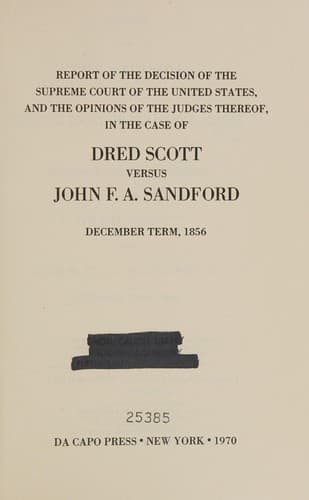
Report of the Decision of the Supreme Court of the United States, and the Opinions of the Judges Thereof, in the Case of Dred Scott versus John F. A. Sandford: December Term, 1856. — John Shaqi
Report of the Decision of the Supreme Court of the United States, and the Opinions of the Judges Thereof, in the Case of Dred Scott versus John F. A. Sandford: December Term, 1856.United States. Supreme Court
History
Report of the Decision of the Supreme Court of the United States, and the Opinions of the Judges Thereof, in the Case of Dred Scott versus John F. A. Sandford: December Term, 1856.
United States. Supreme Court
Scott, Dred, 1809-1858; Slavery -- United States
This question has been examined in the courts of several of the
slaveholding States, and different opinions expressed and conclusions
arrived at. We shall hereafter refer to some of them, and to the
principles upon which they are founded. Our opinion is, that the
question is one which belongs to each State to decide for itself,
either by its Legislature or courts of justice; and hence, in respect
to the case before us, to the State of Missouri--a question
exclusively of Missouri law, and which, when determined by that State,
it is the duty of the Federal courts to follow it. In other words,
except in cases where the power is restrained by the Constitution of
the United States, the law of the State is supreme over the subject of
slavery within its jurisdiction.
As a practical illustration of the principle, we may refer to the
legislation of the free States in abolishing slavery, and prohibiting
its introduction into their territories. Confessedly, except as
restrained by the Federal Constitution, they exercised, and
rightfully, complete and absolute power over the subject. Upon what
principle, then, can it be denied to the State of Missouri? The power
flows from the sovereign character of the States of this Union;
sovereign, not merely as respects the Federal Government--except as
they have consented to its limitation--but sovereign as respects each
other. Whether, therefore, the State of Missouri will recognise or
give effect to the laws of Illinois within her territories on the
subject of slavery, is a question for her to determine. Nor is there
any constitutional power in this Government that can rightfully
control her.
Every State or nation possesses an exclusive sovereignty and
jurisdiction within her own territory; and, her laws affect and bind
all property and persons residing within it. It may regulate the
manner and circumstances under which property is held, and the
condition, capacity, and state, of all persons therein; and, also, the
remedy and modes of administering justice. And it is equally true,
that no State or nation can affect or bind property out of its
territory, or persons not residing within it. No State, therefore, can
enact laws to operate beyond its own dominions, and, if it attempts to
do so, it may be lawfully refused obedience. Such laws can have no
inherent authority extra-territorially. This is the necessary result
of the independence of distinct and separate sovereignties.
Now, it follows from these principles, that whatever force or effect
the laws of one State or nation may have in the territories of
another, must depend solely upon the laws and municipal regulations of
the latter, upon its own jurisprudence and polity, and upon its own
express or tacit consent.
Public-domain text, read in full here on John Shaqi.
Reviews
Reviews
No reviews yet
Be the first to share your thoughts on this work.
Join the Discussion
Join the discussion
Sign in to leave a comment or review.
Sign InorCreate an account