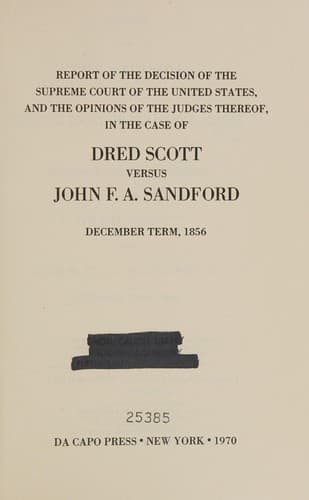
Report of the Decision of the Supreme Court of the United States, and the Opinions of the Judges Thereof, in the Case of Dred Scott versus John F. A. Sandford: December Term, 1856. — John Shaqi
Report of the Decision of the Supreme Court of the United States, and the Opinions of the Judges Thereof, in the Case of Dred Scott versus John F. A. Sandford: December Term, 1856.United States. Supreme Court
History
Report of the Decision of the Supreme Court of the United States, and the Opinions of the Judges Thereof, in the Case of Dred Scott versus John F. A. Sandford: December Term, 1856.
United States. Supreme Court
Scott, Dred, 1809-1858; Slavery -- United States
The argument, we think, in any aspect in which it may be viewed, is
utterly destitute of support upon any principles of constitutional
law, as, according to that, Congress has no power whatever over the
subject of slavery within the State; and is also subversive of the
established doctrine of international jurisprudence, as, according to
that, it is an axiom that the laws of one Government have no force
within the limits of another, or extra-territorially, except from the
consent of the latter.
It is perhaps not unfit to notice, in this connection, that many of
the most eminent statesmen and jurists of the country entertain the
opinion that this provision of the act of Congress, even within the
territory to which it relates, was not authorized by any power under
the Constitution. The doctrine here contended for, not only upholds
its validity in the territory, but claims for it effect beyond and
within the limits of a sovereign State--an effect, as insisted, that
displaces the laws of the State, and substitutes its own provisions in
their place.
The consequences of any such construction are apparent. If Congress
possesses the power, under the Constitution, to abolish slavery in a
Territory, it must necessarily possess the like power to establish it.
It cannot be a one-sided power, as may suit the convenience or
particular views of the advocates. It is a power, if it exists at all,
over the whole subject; and then, upon the process of reasoning which
seeks to extend its influence beyond the Territory, and within the
limits of a State, if Congress should establish, instead of abolish,
slavery, we do not see but that, if a slave should be removed from
the Territory into a free State, his status would accompany him, and
continue, notwithstanding its laws against slavery. The laws of the
free State, according to the argument, would be displaced, and the act
of Congress, in its effect, be substituted in their place. We do not
see how this conclusion could be avoided, if the construction against
which we are contending should prevail. We are satisfied, however, it
is unsound, and that the true answer to it is, that even conceding,
for the purposes of the argument, that this provision of the act of
Congress is valid within the Territory for which it was enacted, it
can have no operation or effect beyond its limits, or within the
jurisdiction of a State. It can neither displace its laws, nor change
the status or condition of its inhabitants.
Our conclusion, therefore, is, upon this branch of the case, that the
question involved is one depending solely upon the law of Missouri,
and that the Federal court sitting in the State, and trying the case
before us, was bound to follow it.
Public-domain text, read in full here on John Shaqi.
Reviews
Reviews
No reviews yet
Be the first to share your thoughts on this work.
Join the Discussion
Join the discussion
Sign in to leave a comment or review.
Sign InorCreate an account