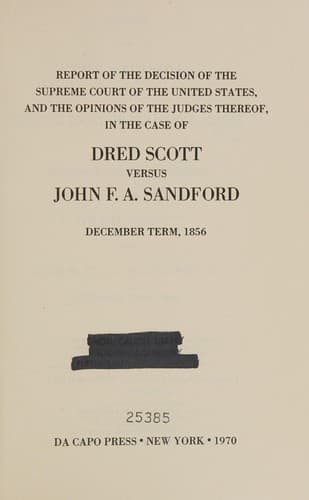
Report of the Decision of the Supreme Court of the United States, and the Opinions of the Judges Thereof, in the Case of Dred Scott versus John F. A. Sandford: December Term, 1856.United States. Supreme Court
History
Report of the Decision of the Supreme Court of the United States, and the Opinions of the Judges Thereof, in the Case of Dred Scott versus John F. A. Sandford: December Term, 1856.
United States. Supreme Court
Scott, Dred, 1809-1858; Slavery -- United States
It has been supposed, in the argument on the part of the plaintiff,
that the eighth section of the act of Congress passed March 6, 1820,
(3 St. at Large, p. 544,) which prohibited slavery north of thirty-six
degrees thirty minutes, within which the plaintiff and his wife
temporarily resided at Fort Snelling, possessed some superior virtue
and effect, extra-territorially, and within the State of Missouri,
beyond that of the laws of Illinois, or those of Ohio in the case of
Strader et al. _v._ Graham. A similar ground was taken and urged upon
the court in the case just mentioned, under the ordinance of 1787,
which was enacted during the time of the Confederation, and re-enacted
by Congress after the adoption of the Constitution, with some
amendments adapting it to the new Government. (1 St. at Large, p. 50.)
In answer to this ground, the Chief Justice, in delivering the opinion
of the court, observed: "The argument assumes that the six articles
which that ordinance declares to be perpetual, are still in force in
the States since formed within the territory, and admitted into the
Union. If this proposition could be maintained, it would not alter the
question; for the regulations of Congress, under the old Confederation
or the present Constitution, for the government of a particular
Territory, could have no force beyond its limits. It certainly could
not restrict the power of the States, within their respective
territories, nor in any manner interfere with their laws and
institutions, nor give this court control over them.
"The ordinance in question, he observes, if still in force, could have
no more operation than the laws of Ohio in the State of Kentucky, and
could not influence the decision upon the rights of the master or the
slaves in that State."
This view, thus authoritatively declared, furnishes a conclusive
answer to the distinction attempted to be set up between the
extra-territorial effect of a State law and the act of Congress in
question.
It must be admitted that Congress possesses no power to regulate or
abolish slavery within the States; and that, if this act had attempted
any such legislation, it would have been a nullity. And yet the
argument here, if there be any force in it, leads to the result, that
effect may be given to such legislation; for it is only by giving the
act of Congress operation within the State of Missouri, that it can
have any effect upon the question between the parties. Having no such
effect directly, it will be difficult to maintain, upon any consistent
reasoning, that it can be made to operate indirectly upon the subject.
Public-domain text, read in full here on John Shaqi.
Reviews
Reviews
No reviews yet
Be the first to share your thoughts on this work.
Join the Discussion
Join the discussion
Sign in to leave a comment or review.
Sign InorCreate an account