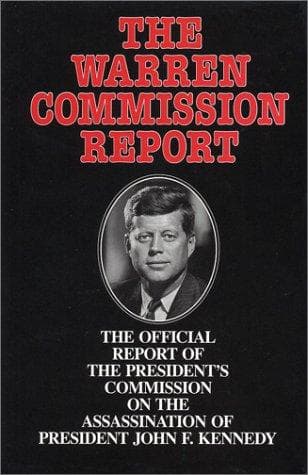
Report of the President's Commission on the Assassination of President John F. KennedyUnited States. Warren Commission
History
Report of the President's Commission on the Assassination of President John F. Kennedy
United States. Warren Commission
Kennedy, John F. (John Fitzgerald), 1917-1963 -- Assassination; Oswald, Lee Harvey
Moreover, rules of law might have prevented the prosecution from
presenting portions of this evidence to the jury. For example, though
expressly recognizing that Oswald’s wife could not be compelled to
testify against him, District Attorney Wade revealed to the Nation that
Marina Oswald had affirmed her husband’s ownership of a rifle like that
found on the sixth floor of the Texas School Book Depository.[C5-250]
Curry stated that Oswald had refused to take a lie detector test,
although such a statement would have been inadmissible in a
trial.[C5-251] The exclusion of such evidence, however, would have been
meaningless if jurors were already familiar with the same facts from
previous television or newspaper reports. Wade might have influenced
prospective jurors by his mistaken statement that the paraffin test
showed that Oswald had fired a gun. The tests merely showed that he had
nitrate traces on his hands, which did not necessarily mean that he had
fired either a rifle or a pistol.[C5-252]
The disclosure of evidence was seriously aggravated by the statements
of numerous responsible officials that they were certain of Oswald’s
guilt. Captain Fritz said that the case against Oswald was “cinched.”
Curry reported on Saturday that “we are sure of our case.”[C5-253]
Curry announced that he considered Oswald sane, and Wade told the
public that he would ask for the death penalty.[C5-254]
The American Bar Association declared in December 1963 that “widespread
publicizing of Oswald’s alleged guilt, involving statements by
officials and public disclosures of the details of ‘evidence,’ would
have made it extremely difficult to impanel an unprejudiced jury and
afford the accused a fair trial.”[C5-255] Local bar associations
expressed similar feelings.[C5-256] The Commission agrees that
Lee Harvey Oswald’s opportunity for a trial by 12 jurors free of
preconception as to his guilt or innocence would have been seriously
jeopardized by the premature disclosure and weighing of the evidence
against him.
The problem of disclosure of information and its effect on trials is,
of course, further complicated by the independent activities of the
press in developing information on its own from sources other than
law enforcement agencies. Had the police not released the specific
items of evidence against Oswald, it is still possible that the other
information presented on television and in the newspapers, chiefly of a
biographical nature, would itself have had a prejudicial effect on the
public.
In explanation of the news policy adopted by the Dallas authorities,
Chief Curry observed that “it seemed like there was a great demand by
the general public to know what was going on.”[C5-257] In a prepared
statement, Captain King wrote:
Public-domain text, read in full here on John Shaqi.
Reviews
Reviews
No reviews yet
Be the first to share your thoughts on this work.
Elsewhere in the archive
Join the Discussion
Join the discussion
Sign in to leave a comment or review.
Sign InorCreate an account