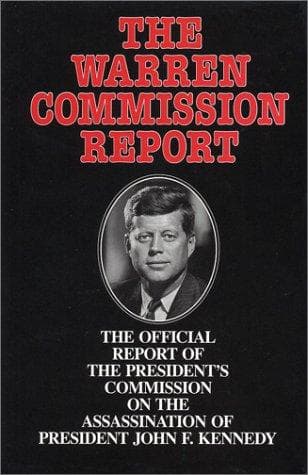
Report of the President's Commission on the Assassination of President John F. KennedyUnited States. Warren Commission
History
Report of the President's Commission on the Assassination of President John F. Kennedy
United States. Warren Commission
Kennedy, John F. (John Fitzgerald), 1917-1963 -- Assassination; Oswald, Lee Harvey
At that time we felt a necessity for permitting the newsmen as
much latitude as possible. We realized the magnitude of the
incident the newsmen were there to cover. We realized that not
only the nation but the world would be greatly interested in
what occurred in Dallas. We believed that we had an obligation
to make as widely known as possible everything we could
regarding the investigation of the assassination and the manner
in which we undertook that investigation.[C5-258]
The Commission recognizes that the people of the United States, and
indeed the world, had a deep-felt interest in learning of the events
surrounding the death of President Kennedy, including the development
of the investigation in Dallas. An informed public provided the
ultimate guarantee that adequate steps would be taken to apprehend
those responsible for the assassination and that all necessary
precautions would be taken to protect the national security. It was
therefore proper and desirable that the public know which agencies were
participating in the investigation and the rate at which their work
was progressing. The public was also entitled to know that Lee Harvey
Oswald had been apprehended and that the State had gathered sufficient
evidence to arraign him for the murders of the President and Patrolman
Tippit, that he was being held pending action of the grand jury, that
the investigation was continuing, and that the law enforcement agencies
had discovered no evidence which tended to show that any other person
was involved in either slaying.
However, neither the press nor the public had a right to be
contemporaneously informed by the police or prosecuting authorities
of the details of the evidence being accumulated against Oswald.
Undoubtedly the public was interested in these disclosures, but
its curiosity should not have been satisfied at the expense of the
accused’s right to a trial by an impartial jury. The courtroom, not the
newspaper or television screen, is the appropriate forum in our system
for the trial of a man accused of a crime.
If the evidence in the possession of the authorities had not been
disclosed, it is true that the public would not have been in a position
to assess the adequacy of the investigation or to apply pressures for
further official undertakings. But a major consequence of the hasty
and at times inaccurate divulgence of evidence after the assassination
was simply to give rise to groundless rumors and public confusion.
Moreover, without learning the details of the case, the public could
have been informed by the responsible authority of the general scope of
the investigation and the extent to which State and Federal agencies
were assisting in the police work.
RESPONSIBILITY OF NEWS MEDIA
Public-domain text, read in full here on John Shaqi.
Reviews
Reviews
No reviews yet
Be the first to share your thoughts on this work.
Elsewhere in the archive
Join the Discussion
Join the discussion
Sign in to leave a comment or review.
Sign InorCreate an account