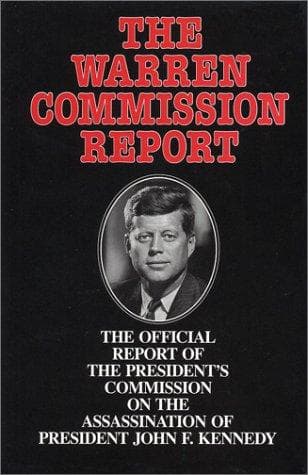
Report of the President's Commission on the Assassination of President John F. KennedyUnited States. Warren Commission
History
Report of the President's Commission on the Assassination of President John F. Kennedy
United States. Warren Commission
Kennedy, John F. (John Fitzgerald), 1917-1963 -- Assassination; Oswald, Lee Harvey
Because of the diligence, cooperation, and facilities of Federal
investigative agencies, it was unnecessary for the Commission to
employ investigators other than the members of the Commission’s legal
staff. The Commission recognized, however, that special measures were
required whenever the facts or rumors called for an appraisal of the
acts of the agencies themselves. The staff reviewed in detail the
actions of several Federal agencies, particularly the Federal Bureau
of Investigation, the Secret Service, the Central Intelligence Agency,
and the Department of State. Initially the Commission requested the
agencies to furnish all their reports relating to the assassination
and their relationships with Oswald or Ruby. On the basis of these
reports, the Commission submitted specific questions to the agency
involved. Members of the staff followed up the answers by reviewing
the relevant files of each agency for additional information. In some
instances, members of the Commission also reviewed the files in person.
Finally, the responsible officials of these agencies were called to
testify under oath. Dean Rusk, Secretary of State; C. Douglas Dillon,
Secretary of the Treasury; John A. McCone, Director of the Central
Intelligence Agency; J. Edgar Hoover, Director of the Federal Bureau
of Investigation; and James J. Rowley, Chief of the Secret Service,
appeared as witnesses and testified fully regarding their agencies’
participation in the matters under scrutiny by the Commission.
COMMISSION HEARINGS
In addition to the information resulting from these investigations, the
Commission has relied primarily on the facts disclosed by the sworn
testimony of the principal witnesses to the assassination and related
events. Beginning on February 3, 1964, the Commission and its staff
has taken the testimony of 552 witnesses. Of this number, 94 appeared
before members of the Commission; 395 were questioned by members of
the Commission’s legal staff; 61 supplied sworn affidavits; and 2
gave statements.[F-4] Under Commission procedures, all witnesses were
advised that they had the right to the presence and the advice of their
lawyer during the interrogation, with the corollary rights to raise
objections to any questions asked, to make any clarifying statement on
the record after the interrogation, and to purchase a copy of their
testimony.[F-5]
Public-domain text, read in full here on John Shaqi.
Reviews
Reviews
No reviews yet
Be the first to share your thoughts on this work.
Join the Discussion
Join the discussion
Sign in to leave a comment or review.
Sign InorCreate an account