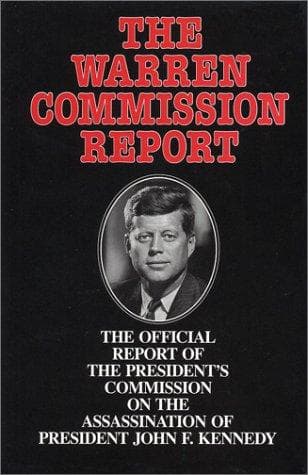
Report of the President's Commission on the Assassination of President John F. KennedyUnited States. Warren Commission
History
Report of the President's Commission on the Assassination of President John F. Kennedy
United States. Warren Commission
Kennedy, John F. (John Fitzgerald), 1917-1963 -- Assassination; Oswald, Lee Harvey
Commission hearings were closed to the public unless the witness
appearing before the Commission requested an open hearing. Under these
procedures, testimony of one witness was taken in a public hearing
on two occasions. No other witness requested a public hearing. The
Commission concluded that the premature publication by it of testimony
regarding the assassination or the subsequent killing of Oswald might
interfere with Ruby’s rights to a fair and impartial trial on the
charges filed against him by the State of Texas. The Commission also
recognized that testimony would be presented before it which would
be inadmissible in judicial proceedings and might prejudice innocent
parties if made public out of context. In addition to the witnesses
who appeared before the Commission, numerous others provided sworn
depositions, affidavits, and statements upon which the Commission
has relied. Since this testimony, as well as that taken before the
Commission, could not always be taken in logical sequence, the
Commission concluded that partial publication of testimony as the
investigation progressed was impractical and could be misleading.
THE COMMISSION’S FUNCTION
The Commission’s most difficult assignments have been to uncover
all the facts concerning the assassination of President Kennedy and
to determine if it was in any way directed or encouraged by unknown
persons at home or abroad. In this process, its objective has been to
identify the person or persons responsible for both the assassination
of President Kennedy and the killing of Oswald through an examination
of the evidence. The task has demanded unceasing appraisal of the
evidence by the individual members of the Commission in their effort to
discover the whole truth.
The procedures followed by the Commission in developing and assessing
evidence necessarily differed from those of a court conducting a
criminal trial of a defendant present before it, since under our system
there is no provision for a posthumous trial. If Oswald had lived he
could have had a trial by American standards of justice where he would
have been able to exercise his full rights under the law. A judge and
jury would have presumed him innocent until proven guilty beyond a
reasonable doubt. He might have furnished information which could have
affected the course of his trial. He could have participated in and
guided his defense. There could have been an examination to determine
whether he was sane under prevailing legal standards. All witnesses,
including possibly the defendant, could have been subjected to
searching examination under the adversary system of American trials.
Public-domain text, read in full here on John Shaqi.
Reviews
Reviews
No reviews yet
Be the first to share your thoughts on this work.
Join the Discussion
Join the discussion
Sign in to leave a comment or review.
Sign InorCreate an account