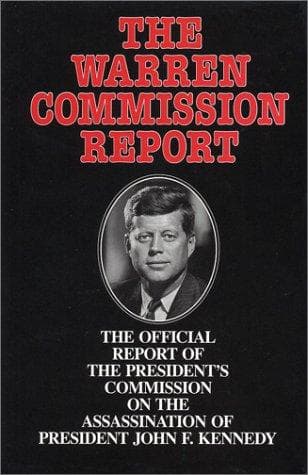
Report of the President's Commission on the Assassination of President John F. KennedyUnited States. Warren Commission
History
Report of the President's Commission on the Assassination of President John F. Kennedy
United States. Warren Commission
Kennedy, John F. (John Fitzgerald), 1917-1963 -- Assassination; Oswald, Lee Harvey
The Commission has functioned neither as a court presiding over an
adversary proceeding nor as a prosecutor determined to prove a case,
but as a factfinding agency committed to the ascertainment of the
truth. In the course of the investigation of the facts and rumors
surrounding these matters, it was necessary to explore hearsay and
other sources of information not admissible in a court proceeding
obtained from persons who saw or heard and others in a position to
observe what occurred. In fairness to the alleged assassin and his
family, the Commission on February 25, 1964, requested Walter E.
Craig, president of the American Bar Association, to participate in
the investigation and to advise the Commission whether in his opinion
the proceedings conformed to the basic principles of American justice.
Mr. Craig accepted this assignment and participated fully and without
limitation. He attended Commission hearings in person or through his
appointed assistants. All working papers, reports, and other data in
Commission files were made available, and Mr. Craig and his associates
were given the opportunity to cross-examine witnesses, to recall any
witness heard prior to his appointment, and to suggest witnesses whose
testimony they would like to have the Commission hear. This procedure
was agreeable to counsel for Oswald’s widow.
THE COMMISSION’S REPORT
In this report the Commission submits the results of its investigation.
Each member of the Commission has given careful consideration to
the entire report and concurs in its findings and conclusions. The
report consists of an initial chapter summarizing the Commission’s
basic findings and conclusions, followed by a detailed analysis of
the facts and the issues raised by the events of November 22, 1963,
and the 2 following days. Individual chapters consider the trip to
Dallas, the shots from the Texas School Book Depository, the identity
of the assassin, the killing of Lee Harvey Oswald, the possibility
of a conspiracy, Oswald’s background and possible motive, and
arrangements for the protection of the President. In these chapters,
rather than rely on cross references, the Commission on occasion has
repeated certain testimony in order that the reader might have the
necessary information before him while examining the conclusions of the
Commission on each important issue.
With this report the Commission is submitting the complete testimony
of all the witnesses who appeared before the Commission or gave sworn
depositions or affidavits, the accompanying documentary exhibits, and
other investigative materials which are relied upon in this report. The
Commission is committing all of its reports and working papers to the
National Archives, where they can be permanently preserved under the
rules and regulations of the National Archives and applicable Federal
law.
Contents
Public-domain text, read in full here on John Shaqi.
Reviews
Reviews
No reviews yet
Be the first to share your thoughts on this work.
Join the Discussion
Join the discussion
Sign in to leave a comment or review.
Sign InorCreate an account