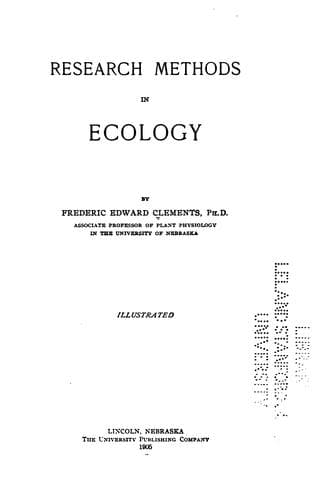
Research methods in ecologyClements, Frederic E. (Frederic Edward)
Science
Research methods in ecology
Clements, Frederic E. (Frederic Edward)
Plant ecology; Plant ecology -- Methodology
=11. Descriptive ecology.= The stage of development of the subject at
the present time may be designated as _descriptive ecology_, for
purposes of discussion merely. This is concerned with the superficial
description of vegetation in general terms, and results from the fact
that the development has begun on the surface, and has scarcely
penetrated beneath it. The organic connection between ecology and
floristic has produced an erroneous impression as to the relative value
of the two. Floristic has required little knowledge, and less
preparation: it lends itself with insidious ease to chance journeys or
to vacation trips, the fruits of which are found in vague descriptive
articles, and in the multiplication of fictitious formations. While
there is good reason that a record should be left of any serious
reconnaissance, even though it be of a few weeks’ duration, the
resulting lists and descriptive articles can have only the most
rudimentary value, and it is absurd to regard them as ecological
contributions at all. No statement admits of stronger emphasis, and
there is none that should be taken more closely to heart by botanists
who have supposed that they were doing ecological work. An almost
equally fertile source of valueless work is the independent treatment of
a restricted local area. The great readiness with which floristic lists
and descriptions can be made has led many a botanist, working in a small
area, or passing hurriedly through an extended region, to try his hand
at formation making. From this practice have resulted scores of
so-called formations, which are mere patches, consocies, or stages in
development, or which have, indeed, no existence other than in the minds
of their discoverers. The misleading definiteness which a photograph
seems to give a bit of vegetation has been responsible for a surplus of
photographic formations, which have no counterparts in nature.
Indispensable as the photograph is to any systematic record of
vegetation, its use up to the present time has but too often served to
bring it into disrepute. There has been a marked tendency to apply the
current methods of descriptive botany to vegetation, and to regard every
slightly different piece of the floral covering as a formation. No
method can yield results further from the truth. It is evident that the
recognition and limitation of formations should be left absolutely to
the broadly trained specialist, who has a thorough preparation by virtue
of having acquainted himself carefully with the development and
structure of typical formations over large areas.
Public-domain text, read in full here on John Shaqi.
Reviews
Reviews
No reviews yet
Be the first to share your thoughts on this work.
Join the Discussion
Join the discussion
Sign in to leave a comment or review.
Sign InorCreate an account